


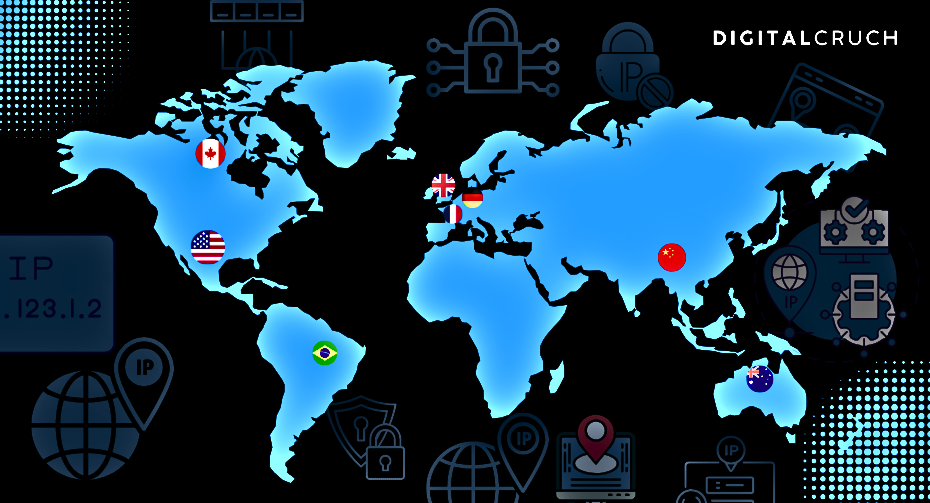
Residential proxies have gone mainstream, earning the trust of SEO professionals, cybersecurity experts, travel companies, web scraping specialists, and eCommerce businesses. Yes, residential proxies are no longer the exclusive domain of data scientists and programmers. Increasingly, businesses, academic researchers, and digital marketers rely on residential IP proxies to navigate the web smoothly while avoiding CAPTCHAs, rate limits, and unnecessary access restrictions.
The key advantage residential proxies have over datacenter proxies is their use of authentic IP addresses issued by Internet Service Providers (ISPs). As a result, websites are far less likely to detect or block them. That is why more businesses across different industries are turning to residential proxy networks than ever before. According to a recent report by Mordor Intelligence, the residential proxy server market is projected to reach USD 148.33 million by 2030. The market stood at USD 122.03 million in 2025, a clear sign that demand for residential proxy services continues to grow.
However, with dozens of residential proxy providers, separating the wheat from the chaff can be a challenge for businesses and individuals. To simplify your decision, DigitalCruch thoroughly reviewed the leading residential proxy providers. Here, we used key criteria, including global IP size & rotation, geographical coverage, connection speed, and overall value. So, whether you are running a lean startup or a large enterprise, this guide takes the guesswork out of finding the right residential proxy service for your needs.
Editorial Disclosure
The DigitalCruch Tech Team independently researched, tested, and reviewed every residential proxy provider featured in this guide. Our evaluations are based on hands-on testing, technical analysis, and real-world performance. No provider has sponsored this article, influenced our rankings, or paid for placement. Our goal is to provide unbiased, evidence-based recommendations to help readers choose the solution that best fits their needs.
Our Top 5 Picks for the Best Residential Proxy Providers
The residential proxy market features several standout providers. Let’s examine industry leaders such as Oxylabs, Bright Data, SOAX, Decodo, and NetNut.
1. Oxylabs
Oxylabs is a powerful residential proxy network spanning 195 countries with a lightning-fast 0.41-second response time. Backed by 175+ million premium IPs, a 99.95% success score, flexible rotation options, and free geo-targeting sessions, it outperforms rivals. Beyond its extensive proxy pool, Oxylabs supports uninterrupted scraping and granular city-level targeting using both static and rotating residential servers.
Best for: While most online reviews position Oxylabs as the go-to choice for large enterprises. But we consider it an all-rounder proxy solution that fits a wide range of use cases. Indeed, with a vast global IP pool, precise geo-targeting and the ability to handle demanding web scraping and data extraction tasks, Oxylabs is an ideal choice for large enterprises. However, Oxylabs goes beyond enterprises, offering scalable tools, automated features, strong privacy, and flexible pricing for smaller businesses and individual users.
Top Server Locations: Its residential IP network covers key regions such as the United States, Germany, the UK, China, France, Canada, Australia, and Brazil.
Features
Robust Protocols – This premium residential IPs provider comes with advanced protocols. First, the QUIC protocol supports HTTP/3 for faster internet connections and improved video streaming. Oxylabs also supports HTTP, SOCKS5 and HTTPS for automation and web scraping.
AI & LLMs Data Collection – Oxylabs is the right choice for gathering high-quality web data for LLM training and AI development. It allows you to extract text-to-video data with maximum accuracy in real-time using AI agents. This network also brings plenty to the table with headless browsing and seamless integration with Copilot, Claude, and Cursor.
SEO Monitoring and Web Scraping – You can track search engine ranking and conduct SERP analysis on the fly without getting blocked with these safelisted IPs. Similarly, Oxylabs residential proxies support large-scale scraping with rotating IPs, helping businesses collect accurate data while reducing blocks and CAPTCHAs.
Ad Verification – Are you a brand or a digital marketer and looking for ad verification while keeping complete anonymity? If so, these rotating residential IPs would help you bypass geo-restricted ad verifications across platforms like Facebook, Google, and Amazon.
Cybersecurity & Developer-centric Integrations – Security teams stay one step ahead by analyzing malware infrastructure, phishing sites, and fraudulent domains without exposing corporate IPs. On the other hand, these IPs give developers the edge by supporting reliable scraping across Python, C#, Go, Node.js, Java, PHP, and more.
Easy Integrations – You can also make integration a breeze with third-party tools like Selenium, Scrapy, Puppeteer, Playwright, and Multilogin with these IPs.
Drawbacks of Using Oxylabs Residential Proxies
- It may feel like a stretch for budget users due to its premium pricing compared with alternatives.
- Users with basic needs may find this enterprise proxy unnecessary for simple browsing, geo-testing, or smaller projects.
- Oxylabs has a steep learning curve, requiring new users to spend time understanding features and maximizing platform capabilities.
Pricing
Oxylabs costs you $30/month for its Starter 5GB package. Its Basic plan is most popular, with a monthly price tag of $100 for a 20GB package. For heavy usage, Oxylabs Advanced and Corporate plans cost $500 and $2,500 monthly, offering 125GB and 1TB data allowances respectively.
2. Bright Data (Luminati)
Bright Data, formerly known as Luminati, delivers over 400 million residential IPs spanning 195 countries, helping you browse the world without limits. With a blazing-fast response time of ~0.7 seconds, Bright Data is one of the few proxy services that ensures 99.95% success alongside free geolocation targeting. Similarly, it rounds out its performance with 99.99% uptime, giving competitors a run for their money in terms of reliability.
Best for: Bright Data is an excellent choice for enterprise and data-driven teams where compliance takes center stage. Indeed, compliance-heavy industries can trust this IP provider for identifying region-centric phishing campaigns to web scraping. In addition, this platform also combines a vast IP pool with rotating IPs and sticky sessions, helping you switch gears without skipping a beat.
Top Server Locations: From the United States and the United Kingdom to China, Brazil, France, Canada, Spain, Germany, Australia, and Japan, Bright Data offers extensive global IP coverage.

Features
Ethical Web Scraping – Bright Data puts ethics and compliance at the heart of its proxy network, offering consent-based IPs that help businesses stay on the right side of the line. In this regard, this home IP provider meets strict compliance standards, including GDPR, CCPA, ISO 27701, CSA STAR, and the EU data protection framework.
Advanced Protocols – This proxy vendor equips users with multiple advanced protocols, helping every connection run smoothly without missing a beat. First, Web MCP (Model Context Protocol) empowers LLMs and AI agents to access real-time web data. In contrast, Bright Data uses the QUIC protocol to deliver near-instant responses.
Accurate Ad Verifications & SERP Tracking – You can tap into AdTech features to conduct reliable ad verification using real user IPs across a global network of 200+ countries. Beyond broad location targeting, Bright Data lets you customize connections by choosing specific ASNs, ZIP codes, cities, and countries. Similarly, you can integrate SERP API to monitor your SEO campaigns over multiple search engines, including Yandex, Bing, and Google.
Easy Integration & Start – Whether you manage an eCommerce store or handle social media accounts, Bright Data enables seamless integrations with various tools. Yes, you can easily pair this residential proxy with DuoPlus, MarketerBrowser, Shopify, Magento, and countless other tools to streamline your workflow. Meanwhile, dev teams can easily integrate this residential proxy into any application by adding a minimal script.
Drawbacks of Using Bright Data Residential Proxies
- Bright Data is considered a premium-priced option because it charges based on GB consumption rather than offering fixed-rate plans.
- Some users raise concerns about its IP sourcing practices and potential conflicts with website terms and conditions.
Pricing
Bright Data follows a pay-as-you-go pricing model for its residential IPs. It costs $4/GB (with a 50% discount) without a monthly commitment. By the same token, small businesses would have to pay $3.50/GB (with a 50% discount) and $499/month for standard usage. This proxy provider scales its pricing for bigger users, charging $999 per month for large teams and $1,999 for enterprises.
3. Decodo
Decodo earns its place on our list with a scalable residential proxy network built on ethically sourced IPs. With a network of 115 million residential proxies in over 195 countries, Decodo ensures a 99.92% success score. It channels your internet requests through authentic home IPs to reduce the risk of anti-bot blocks. Stable connections, flexible rotating and static sessions, and 0.5-second response time set Decodo apart in the proxy market.
Best for: If you think the DigitalCruch team overlooked freelancers, small businesses, and marketing teams in this hands-on review, think again. We recommend Decodo for solo developers, small marketers, and growing companies looking to start with free residential proxies. Beyond that, Decodo handles everything from account management and market research to ad verification and high-volume web scraping.
Top Server Locations: Decodo offers residential IP coverage across key regions, including the United States, Germany, India, Canada, Japan, and the United Kingdom.

Features
Suitable for AI Projects – AI models require extensive and dynamic datasets, and Decodo can help. Its rotating residential IPs help gather geographically distributed content to minimize algorithmic bias and sustain success score. You can also integrate these proxies with tools like MCP Server, OpenClaw, the Web Scraping API, n8n, LangChain, and AI Parser to streamline workflows.
Rotating & Sticky Sessions – Decodo gives you complete control over IP rotation with per-request, sticky-session, and scheduled time-interval rotation. On the other hand, its static residential (ISP) proxy network combines unlimited threads with concurrent sessions. This capability ensures consistent performance, even in CAPTCHA-intensive environments.
Developer-Ready Network – If you need a ready-to-use residential proxy network for your development team, Decodo is an excellent choice. It features developer-friendly APIs and clear documentation, making it easy to integrate with Python, Java, JavaScript, Go, and Node.js using only a few lines of code.
Ad Verifications & QA Testing – Like the industry’s top residential proxy providers, Decodo supports precise geo-targeted ad verification through its vast residential IP network. Beyond that, QA teams can validate localized user experiences, while SEO teams can track keyword rankings and search results without hassle.
Security & Compliance – Decodo follows ISO/IEC 27001 standards and data protection regulations, providing secure scraping APIs and residential IPs that reduce privacy risks.
Drawbacks of Using Decodo Home IPs
- Although reliable, but Decodo experiences occasional IP blocklisting more frequently than Oxylabs and Bright Data.
- The lower-tier plans provide limited geographic coverage and only a short trial period.
- Pricing becomes more expensive as your usage grows, and the pay-as-you-go rates are relatively high.
Pricing
Decodo makes it easy to explore its platform with a Start for Free trial available to all newly registered users. With the free plan, you receive 100 MB of residential proxy traffic, valid for 3 days. However, Decodo’s Regular plan starts at $2/GB. Its most popular plan costs $3.25/GB and includes 25 GB of residential proxy traffic. For larger deployments, Decodo’s Enterprise plan starts at $625 per month and provides 250 GB of traffic.
4. IPRoyal
IPRoyal delivers a versatile residential proxy network that excels at sneaker copping, web scraping, and geo-targeted ad verification. Backed by a robust network of 64 million rotating residential IPs across more than 195 countries, IPRoyal stands out as another strong choice in our roundup. Its response times of around 0.5 seconds and a 99.4% success rate further set IPRoyal apart in the residential proxy market.
Best for: Whether you are an individual developer, a fast-growing startup, a data team, or a large enterprise, IPRoyal delivers a highly tailored and scalable setup. Although it scales well, but IPRoyal remains a favorite among freelancers and growing teams. You can use it for copyright protection monitoring, CAPTCHA-intensive tasks, eCommerce automation, ad tech operations, and similar workflows.
Top Server Locations: IPRoyal residential proxy IPs are available across the United States, France, Italy, the Netherlands, Germany, Spain and the United Kingdom.
Features
More Control – A defining feature of IPRoyal is its ability to give users precise control over their proxy settings. Yes, from manually switching IP addresses to maintaining a rotating IP for up to 7 days, this proxy gives you the flexibility to manage your connections your way.
Concurrent Sessions & Protocols – IPRoyal also stands out by offering unlimited concurrent sessions with dedicated residential IPs. This platform supports protocols like SOCKS5 and HTTP(S) to maintain user anonymity while giving you access to non-expiring IPs and bandwidth.
Seamless Data Extraction & Ad Verifications – It uses powerful web scraping tools to improve access to geo-restricted content and reduce the likelihood of bot detection. Likewise, ad verification companies widely use IPRoyal’s residential proxies to detect and prevent ad fraud. As a result, this service combines fine-grained geo-targeting with location filtering at the country, city, ISP, and ZIP code levels.
Proxies for YouTube – A common misconception is that people in China and Russia use VPNs exclusively to access YouTube. But in reality, when it comes to accessing platforms like YouTube, residential proxies often prove more reliable than traditional VPNs. Hereof, IPRoyal is one of the top choices. Its YouTube proxies support reliable access by handling geo-restrictions, IP-based blocks, and frequent CAPTCHA checks.
Drawbacks of Using IPRoyal IPs
- Although it seems good for individuals and small businesses but, the cost climbs when you scale your operations.
- Advanced features such as IP rotation, proxy configuration, and compliance management require technical expertise.
- Unstable connection speed and a small IP pool are also drawbacks of using IPRoyal residential IPs.
Pricing
IPRoyal offers you both pay-as-you-go and subscription-based pricing models. Under its subscription pricing, the 1 GB plan costs $7 per GB, whereas the 10 GB package reduces the rate to $5.25 per GB. In contrast, its best-selling PAYG package offers 10 GB of residential proxy traffic at $5.51/GB.
5. Webshare
Webshare is another reliable rotating residential IP service with 80 million ethically obtained IPs and 256k satisfied customers. With fewer IP blocks and extensive coverage across 195 countries and major cities, Webshare stands out as a dependable solution for professional users.
Best for: Webshare delivers outstanding value for solo developers, startups, and small to medium-sized teams seeking affordable residential proxies. With entry-level pricing, Webshare supports a wide range of use cases, from ad verification and SEO monitoring to web scraping.
Top Server Locations: Its global proxy network provides reliable coverage throughout the United States, the United Kingdom, Italy, France, Canada, Spain, Germany, and the Netherlands.

Features
ISP & Rotating IPs – One of the primary things that you must consider while buying a residential proxy is the inclusion of both ISP and rotating IPs. Fortunately, Webshare offers both. You can use static IPs for everything from web scraping to long-term account management tasks that require a consistent online identity. Besides, with rotating capability, you can get a fresh IP for each request.
Amazon Proxy Server – Webshare equips users with a fully customizable Amazon Proxy Server designed for Amazon-related workflows. It retrieves public Amazon data across 50+ countries, enabling businesses to track customer reviews, product prices, and competitor insights.
Ad Verification & SEO Tracking – These home IPs let advertisers use proxies to simulate genuine user traffic. They leverage proxies to identify fraudulent ad activity and ensure ads display correctly across target markets. Similarly, SEO teams rely on residential networks to track keyword positions and monitor localized search results.
Seamless Connections – The platform makes it easy to connect with your development stack and existing workflows. You can copy and integrate ready-made code samples for Python, cURL, Go, C#, Java, Node.js, and PHP into your existing stack to launch web scraping workflows with minimal setup.
Drawbacks of Using Webshare IPs
- Webshare acknowledges that its static residential IPs operate on high-performance servers. As a result, some proxy detection tools may label them as datacenter or VPN IPs.
- Although Webshare advertises 99.97% uptime, but a configuration change caused an ~8-hour outage.
- Limited documentation for rotating residential proxies is one of Webshare’s notable drawbacks.
Pricing
Webshare uses usage-based pricing for its residential proxy service, so you pay only for the bandwidth you consume. Pricing starts at $3.50 per GB. However, if you choose the 10 GB or 100 GB plan, Webshare lowers the rate to $2.75/GB and $2.25/GB, respectively.
Things to Consider While Choosing a Residential Proxy
Review the following checklist to ensure you choose the right residential proxy plan for your needs:
IP Pool Size & Freshness
You shouldn’t judge a residential proxy service by its advertised IP count alone. Verify how many IPs remain active at any given moment and how often the provider refreshes its network.
Rotating IPs vs Sticky Sessions
A quality residential proxy provider should support both automatic IP rotation and configurable sticky sessions. Before committing to a provider, verify whether these features are bundled with your chosen plan or limited to higher-tier subscriptions, as pricing structures can vary significantly.
Account Verification Policy
Some proxy sites perform enhanced verification after account creation when they detect automated or high-risk activity. Checking the verification policy before signing up helps prevent unexpected delays, especially when fast onboarding or privacy is a priority.
IP Quality & Geo-Targeting Granularity
You must cross-check the quality of IPs before making a deal. It is important to verify that your residential IPs are not ISP-backed IPs that are run on datacenter infrastructure. You must also evaluate the provider’s geo-targeting capabilities to see whether they support city- and ASN-level targeting or only country-level locations.
Pricing Structure & Support Service
Before subscribing, you must determine whether a pay-as-you-go or fixed pricing model better suits your workload and long-term costs. Beyond pricing and performance, evaluate the quality of the provider’s post-purchase support.
Final Words
Ultimately, no single residential proxy provider outperforms every competitor in every scenario. The best choice is the one that delivers the right balance of performance, features, pricing, and scalability for your specific requirements. For example, when reliability, scalability, and compliance matter more than price, Bright Data and Oxylabs remain among the strongest choices for enterprise deployments.
In contrast, Decodo doesn’t compete with Bright Data or Oxylabs on sheer scale. Instead, it differentiates itself through an intuitive user experience, competitive mid-tier pricing, and the right balance of features for startups, SMBs, and growing teams. For cost-conscious users and early-stage projects, IPRoyal and Webshare provide accessible pricing and a low barrier to entry. Before expanding your workload, test their IP reliability and support responsiveness with the websites you plan to target.
In practical terms, choosing a residential proxy provider is about finding the best fit for your workload, not the biggest brand. Test the provider’s rotation options, geo-targeting precision, and pricing against your actual workload before scaling your deployment.
