GRC, or Government Risk and Compliance, is highly significant in cybersecurity. This systematic approach is typically used to harmonize IT with a business’s core competencies. In this regard, GRC helps improve cybersecurity, make data-driven decisions, and simplify operations.
Let’s explore it in detail.
What is GRC in Cyber Security?
Government, Risk, and Compliance (GRC) in cybersecurity refers to an organized approach that links IT functions with enterprise strategies to fulfill regulatory mandates and address vulnerabilities. GRC offers a diverse set of tools to align a company’s governance functions and risk administration with recent tech breakthroughs.
In simple terms, businesses employ GRC to achieve organizational goals and comply with standards without ambiguity.
3 Key Components of GRC
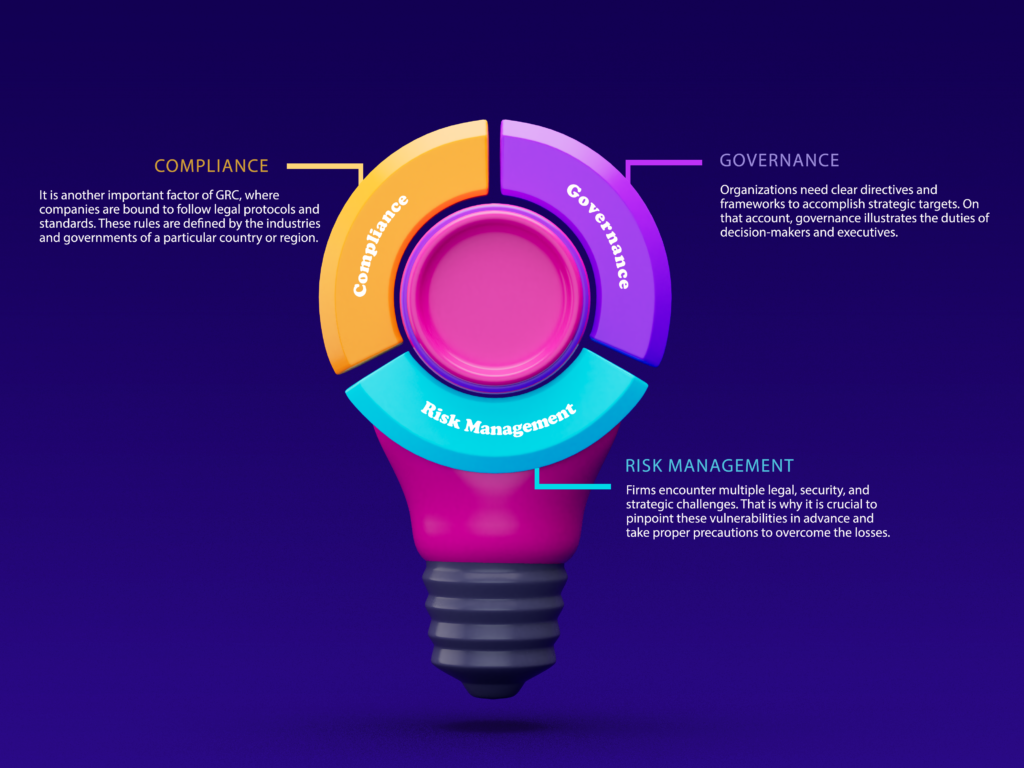
Compliance, governance, and risk management are three components of GRC cybersecurity. Let’s break them down individually:
Governance: Organizations need clear directives and frameworks to accomplish strategic targets. On that account, governance illustrates the duties of decision-makers and executives. Moreover, transparent data distribution, fair resource allocation, and dispute settlement are also part of good governance.
Risk Management: Firms encounter multiple legal, security, and strategic challenges. That is why it is crucial to identify these vulnerabilities in advance and take appropriate precautions to mitigate losses.
Compliance: Another vital factor of the GRC is that companies are bound to follow legal protocols and standards. The industries and governments of a particular country or region define these rules.
Importance of GRC in Cyber Security?
GRC has a significant impact on cybersecurity and other top-tier software fields. Indeed, GRC programs assist organizations in fulfilling legal mandates, making optimal business choices, and mitigating risks.
Have a look at the major pros of GRC cybersecurity:
Transparent & Efficient Operations
GRC simplifies business practices, enabling you to develop a transparent working environment for individuals and businesses. This transparency leads to principled decision-making in companies. Correspondingly, the use of reliable GRC software and frameworks helps businesses save time.
Yes, companies need to spend a lot of time on auditing, risk management, compliance, and related activities. However, GRC software streamlines these operations.
Risk Identification & Mitigation
Government, Risk, and Compliance frameworks authorize firms to create, manage, and streamline risk assessment and mitigation. Businesses make data-driven judgments using GRC information. Likewise, companies use ERM (enterprise risk management) strategies to address vulnerabilities. Similarly, the Sarbanes-Oxley Act serves a vital purpose by safeguarding sensitive data and ensuring financial audits.
Improved ROI and Performance
It is challenging for organizations to take proper measures to allocate resources, handle disputes, and follow a code of conduct. However, the GRC IT approach and metrics play an important role in defining objectives. Therefore, operations become more productive and deliver greater returns on investment.
How to Implement a Successful GRC Strategy?
Implementing a successful GRC strategy for your company is a daunting task, but by following these steps, you can cut:
Set Concrete Targets & Establish the GRC Model
First, you need to identify potential threats and challenges to lay the foundation for your GRC model. This helps you determine which areas you should emphasise more. After building a proper framework, businesses can seamlessly mitigate vulnerabilities and make informed decisions.
Identify Your Current Operational Flaws
Organizations must avoid operational flaws to improve productivity and work efficiency. In this regard, you must first discover these functional drawbacks and then fix them. Likewise, there is always room for technological and security improvements. Similarly, you must monitor discrepancies related to third parties.
Gain Support from Senior Management
You are wrong if you think you can successfully implement a GRC framework without the endorsement of top-level management. Indeed, business executives’ commitment to managing risks, complying with regulations, and administering resources is pivotal.
Obtain Company-Wide Approval
After securing support from senior management, it is time to gain backing from the entire company. All employees should take GRC as a mutual responsibility. Otherwise, it will be challenging for cybersecurity specialists to implement this framework within a company fully.
Assign Explicit Roles & Duties
Different personnel and executives must be aware of their teamwide duties. For example, supervisory bodies and CEOs are liable for inspecting and validating the GRC model. By the same token, the CRO, or Chief Risk Officer, oversees daily monitoring of vulnerabilities.
Moreover, the roles of the CTO, CIO, LOB managers, and CCO are significant for conducting internal audits and employing recent financial and tech approaches.
Employ GRC Software
Word processors like Google Docs or MS Word, and spreadsheets are not good ideas for executing a GRC strategy. That is why we suggest employing proper GRC software and tools. Some of them are AuditBoard, Archer, and IBM OpenPages.
Evaluate the Effectiveness of the GRC Framework
Companies should also monitor the effectiveness of this framework after implementation. If any flaw or an update is required, you should address it immediately to avoid embarrassment.
Top 4 GRC Cybersecurity Tools to Use in 2025
Here are the leading GRC tools & software:
Archer—This high-performing risk administration offering is typically used to evaluate and handle operational challenges. Archer provides tailored reports and secures infrastructure assets through a user-friendly interface.
AuditBoard—It is a trustworthy risk management platform established to simplify compliance procedures, audits, and the identification of organisational hazards. ESG management, automated workflows, and easy integration with other platforms are also pros of AuditBoard.
IBM OpenPages—With various Software as a Service, Platform as a Service (PaaS), and Backend as a Service (BaaS) solutions, IBM offers a unified GRC product. Yes, IBM OpenPages provides a highly scalable GRC environment backed by AI.
MetricStream—This tool follows multiple strategies to align compliance, cybersecurity, and audit within companies. It is mainly known for its third-party, operational, and enterprise-grade risk management approaches.
What are the Common Challenges of GRC Implementation?
You must have a look at the challenges before carrying out GRC:
- It is hard for employees and senior management to accept the change.
- Companies face difficulties while syncing GRC frameworks with legacy systems.
- Businesses usually have limited or no budget to hire GRC experts or to allocate resources.
- Ambiguity in communication, alignment with business goals, and the overwhelming nature of managing are also key challenges here.
Is GRC a Good Career?
GRC is an excellent career for computer science students or software engineers interested in cybersecurity. The demand for such experts is high in the IT industry. Similarly, the median salary for a GRC engineer in the United States is $106K-$181K/year. However, the stakes are high because these personnel work for the company’s security.
Final Words
Employing the GRC model has become pivotal for businesses, helping them overcome resource wastage, optimize efficiency, and prevent compliance pitfalls. Therefore, this article explores various aspects of GRC in cybersecurity, including challenges and available software.