


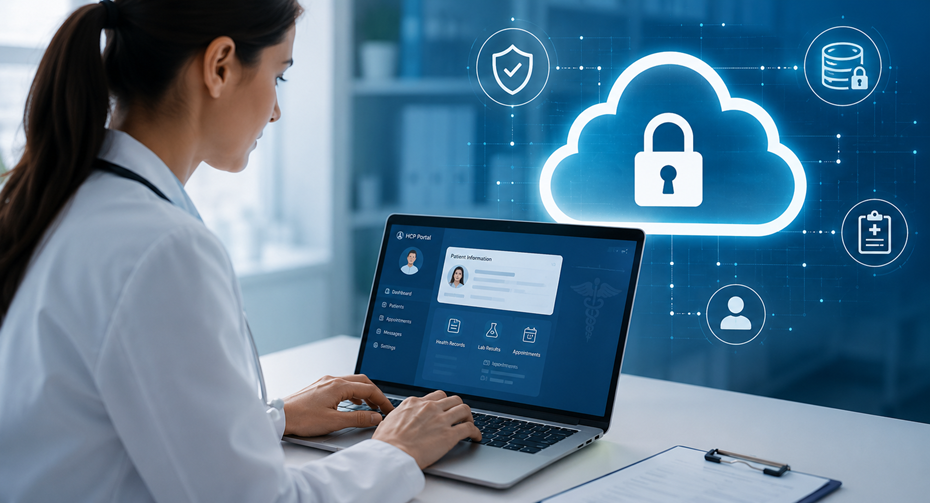
Healthcare provider (HCP) portals sit at the center of modern care delivery. Physicians log in to check lab results. Nurses update charts between rounds. Billing teams pull insurance data. Every one of these actions touches electronic protected health information (ePHI), and every one of these actions creates risk. In 2026, that risk carries a bigger price tag than ever before. That is why the use of cloud security practices for securing patient data in HIPAA-compliant HCP portals is snowballing among healthcare providers.
Healthcare breach costs now average $7.42 million per incident, the highest of any industry tracked, and healthcare has held that unwanted title for 14 straight years. Ransomware drives roughly 48% of confirmed healthcare breaches. Detection and containment still take an average of 279 days, five weeks longer than the global cross-industry average. These numbers aren’t abstract. They represent real patient records, real clinical downtime, and real regulatory exposure for any organization running an HCP portal in the cloud.
This article pulls together current data from IBM’s Cost of a Data Breach Report, the Verizon Data Breach Investigations Report, HHS OCR breach portal filings, NIST zero trust guidance, and multiple 2026 healthcare cybersecurity trackers. It also factors in the pending HIPAA Security Rule update, first proposed by HHS in January 2025, which would make encryption and multi-factor authentication mandatory rather than “addressable.” The goal here isn’t to sell a platform or push one cloud vendor over another. It’s to lay out five cloud security practices that actually move the needle for HIPAA-compliant HCP portals, backed by numbers instead of guesswork.
Why HCP Portals Face Unique HIPAA Risk in 2026?
HCP portals differ from typical enterprise web apps in one critical way: nearly every data field qualifies as protected health information. Names, diagnoses, insurance IDs, and treatment notes sit together in the same record. Attackers know this, and they price stolen medical records accordingly. A stolen medical record often sells for ten times more than a stolen credit card number on dark web markets, because health data doesn’t expire the way a card number does.
Business associate breaches have compounded the problem. According to Verizon’s 2025 DBIR, the share of healthcare breaches tied to a business associate doubled year over year, from 15% to 30%. Covered entities remain legally responsible for notifying affected individuals even when a business associate handles the breach response. That single fact should shape how every HCP portal operator evaluates its cloud vendors, subcontractors, and API integrations going into 2026.
Regulators are responding. The proposed HIPAA Security Rule update, still pending as of mid-2026, would remove the “addressable” loophole around encryption and require multi-factor authentication across every system that touches ePHI, along with 72-hour breach notification and annual penetration testing. Whether or not the final rule lands on schedule, the direction is clear enough that waiting for enforcement is no longer a defensible strategy.
With that backdrop in place, here are the five cloud security practices every HIPAA-compliant HCP portal needs to prioritize this year.
5 Cloud Security Practices Every HIPAA-Compliant HCP Portal Needs
Take a look at the following practices. Each one addresses a different point of failure, from the moment a user logs in to the moment a backup gets restored after an attack.
1. Zero Trust Security
Zero trust replaces the old “trust everything inside the network” model with a simpler rule: verify every request, every time, regardless of where it originates. For an HCP portal, that means a nurse’s laptop, a physician’s phone, and a billing vendor’s API connection all get treated the same way: as unverified until proven otherwise.
Healthcare has been slower to adopt this model than finance, but the gap is closing fast. Zero trust adoption in healthcare now sits near 35%, trailing financial services at roughly 50% but still well ahead of manufacturing. The global zero trust market itself has grown into a multibillion-dollar category, and healthcare represents one of its largest verticals because hybrid environments (cloud EHRs, on-premises servers, connected medical devices) create exactly the kind of scattered attack surface zero trust was designed to handle.
NIST Special Publication 800-207 defines the architecture around seven core elements: identity, devices, networks, applications, data, infrastructure, and visibility. For an HCP portal, the practical version usually starts with microsegmentation, so a compromised scheduling module can’t reach the billing database. It continues with continuous device health checks, so an unpatched laptop can’t authenticate even with valid credentials. And it wraps up with policy engines that adjust access based on context, since location, device posture, and time of day all factor into the decision.
Organizations that have implemented zero trust report a meaningful financial benefit too. Breach costs at organisations running mature zero trust programs are about $1.76 million lower per incident than those without it, largely because containment happens faster when lateral movement is restricted from the start. For an HCP portal handling thousands of patient records daily, that containment speed can be the difference between a contained incident and a reportable breach affecting an entire patient population.
The catch is execution. Roughly 82% of healthcare organizations consider zero trust essential, yet only a small fraction have implemented it at full maturity. Tool sprawl is the most commonly cited barrier. Stacking point solutions from multiple vendors without a unified policy engine creates gaps rather than closing them. Starting with identity and device pillars, then expanding into network segmentation, tends to produce faster wins than attempting a full rebuild at once.
2. Identity and Access Management (IAM)
If zero trust is the philosophy, IAM is the enforcement layer. Every login to an HCP portal needs to answer three questions instantly: who is this, what are they allowed to touch, and does this request look normal for them? Weak IAM remains one of the most common entry points for healthcare attackers, and credential-based intrusions still rank among the top breach patterns tracked by Verizon’s annual report.
Modern IAM for healthcare portals typically layers several controls together. Single sign-on reduces password fatigue among clinical staff who juggle a dozen applications per shift. Role-based access control limits a scheduling coordinator to scheduling data, keeping clinical notes out of reach unless the role explicitly requires it. Multi-factor authentication, soon to be mandatory rather than optional under the pending HIPAA Security Rule, blocks most credential-stuffing and phishing-driven account takeovers before they reach patient data.
Privileged access management deserves its own line item. Admin-level accounts, the ones that can export full databases or change portal-wide permissions, need just-in-time provisioning instead of standing access. A vendor consultant who needs database access for a two-hour migration shouldn’t retain that access for months afterwards. Just-in-time PAM closes that exact gap, and it’s becoming a standard expectation in healthcare zero trust roadmaps for 2026.
Identity governance also extends outward to third parties. Given that business associate breaches now account for roughly 30% of healthcare incidents, every vendor, API integration, and contractor login into an HCP portal deserves the same scrutiny as an internal employee account. Regular access reviews, automatic deprovisioning when contracts end, and audit logs tied to individual identities, not shared service accounts, all reduce the blast radius when something does go wrong.
Vendors across this space, including Okta, Microsoft Entra, and Cisco Duo, offer overlapping capabilities here, and the right fit depends on an organization’s existing identity stack rather than any single platform being universally superior. What matters more than the brand is whether MFA coverage reaches 100% of systems touching ePHI, since partial coverage leaves an obvious door open.
3. Data Encryption
Encryption is the control that turns a stolen database into an unreadable file. It’s also the single most consistently cited requirement across every version of the pending HIPAA Security Rule update. Encryption of ePHI at rest and in transit, without exception language, is expected to become mandatory rather than “addressable” once the rule finalizes.
At rest, that means patient records sitting in cloud storage, backups, and databases all need strong encryption, typically AES-256 or equivalent, with keys managed separately from the data itself. In transit, it means every connection between a clinician’s device and the portal server runs over TLS, and every API call between the portal and connected systems, including lab platforms, pharmacy networks, and insurance clearinghouses, stays encrypted end to end.
Key management often gets less attention than the encryption algorithm itself, but it matters just as much. Cloud providers including AWS, Microsoft Azure, and Google Cloud all offer dedicated key management services that let healthcare networks control who can decrypt data and when. Customer-managed keys, rather than provider-default keys, give covered entities an extra layer of control that auditors increasingly expect to see documented.
Field-level encryption adds another useful layer for HCP portals specifically. Rather than encrypting an entire database as one block, sensitive fields such as Social Security numbers, diagnosis codes, and insurance IDs get encrypted individually. That approach limits exposure even if an application-layer vulnerability lets an attacker query the database directly, since the returned fields remain unreadable without the corresponding keys.
Looking further ahead, post-quantum cryptography is starting to enter healthcare security planning. NIST published its first post-quantum encryption standards in 2024, and forward-looking IT teams are building “crypto-agility” into their systems now, so algorithms can be swapped without a full platform rebuild once quantum-resistant standards mature further. It’s not an urgent 2026 requirement, but it’s a smart line item for any multi-year cloud security roadmap.
4. Threat Detection and SIEM
Encryption and IAM reduce the odds of a breach. Threat detection determines how fast an entity notices one when prevention fails, and in healthcare, that detection speed has been dangerously slow. The average healthcare breach still takes 279 days to identify and contain, well above the cross-industry average, which gives attackers months of undetected access to patient data.
Security Information and Event Management (SIEM) platforms close that gap by pulling logs from every layer of the portal, including application access, network traffic, identity events, and endpoint activity, into a single monitoring view. Instead of a security team manually checking a dozen dashboards, a SIEM correlates events automatically and flags patterns that look like an attack in progress: unusual login times, data exports far larger than normal, or access attempts from unfamiliar geographies.
Modern SIEM deployments increasingly pair with SOAR (security orchestration, automation, and response) to shorten the gap between detection and action. When a SIEM flags a compromised account, an integrated SOAR workflow can automatically suspend that account, alert the security team, and preserve forensic logs, all within minutes rather than hours. For an HCP portal under attack, that speed directly limits how many patient records an attacker can reach before being cut off.
AI-driven anomaly detection has become a standard feature across major SIEM platforms from vendors like Microsoft Sentinel, IBM QSRadar’s successors, Palo Alto Networks Cortex, and CrowdStrike Falcon. These systems build a behavioral baseline for each user and system, then flag deviations that rule-based systems alone would miss. A physician account suddenly querying thousands of unrelated patient records is one example, even if the login credentials themselves look legitimate.
Threat intelligence feeds strengthen the picture further by cross-referencing detected activity against known ransomware indicators and attacker infrastructure. Given that healthcare accounts for roughly 17% of all ransomware attacks across every industry tracked, and ransomware groups increasingly reuse tools and infrastructure across victims, a SIEM tied into current threat intelligence catches attacks that a standalone system would miss until it was too late.
5. Cloud Backup and Disaster Recovery
Every practice above works to prevent or catch an intrusion. Backup and disaster recovery (DR) exist for the moment those defenses fail anyway. Ransomware doesn’t just steal data anymore. It encrypts production systems and demands payment for the decryption key, and healthcare’s average ransom demand runs into the millions of dollars. A tested, isolated backup turns that demand into a non-event.
The word “isolated” carries real weight here. Attackers routinely search for and encrypt connected backup systems before deploying ransomware on the primary environment, specifically to remove the recovery option and increase pressure to pay. Immutable backups, meaning storage that cannot be altered or deleted, even by an administrator account, for a defined retention period, close that gap. Most major cloud providers now offer immutable storage tiers built specifically for this scenario.
Recovery time objective (RTO) and recovery point objective (RPO) deserve explicit documentation for any HCP portal, not just informal assumptions. RTO defines how quickly systems must come back online; RPO defines how much data loss is acceptable, measured in time. A portal handling active patient scheduling might need an RTO measured in hours, while a portal used mainly for historical record lookup can tolerate more. The pending HIPAA Security Rule update is expected to formalize this further, requiring documented restoration timeframes rather than leaving contingency planning loosely defined.
Testing separates a real disaster recovery plan from a document sitting in a drawer. Health units that never test their backups in a recovery environment expose themselves to hidden risks. They may discover corrupted files, missing dependencies, or configuration drift only when a real crisis occurs. Similarly, the healthcare units that run scheduled recovery drills consistently achieve faster real-world recovery times. They identify and fix process issues before a crisis occurs, ensuring the recovery plan works when it matters most.
Geographic redundancy rounds out a solid DR strategy. Storing backups across multiple regions protects against not just cyberattacks but also regional outages, natural disasters, and provider-side failures. AWS, Microsoft Azure, and Google Cloud all support multi-region backup configurations, and for HCP portals serving patients across state lines, that redundancy also supports uptime commitments built into service-level agreements with provider networks.
Comparing 5 Cloud Security Practices for HCP Portals
| Practice | Primary Risk It Addresses | Key HIPAA Connection | Common Vendor Categories |
|---|---|---|---|
| Zero Trust Security | Lateral movement after initial compromise | Access control & minimum necessary standard | Microsoft Entra, Palo Alto Networks, Cisco, Cloudflare |
| Identity and Access Management | Credential theft, insider misuse, third-party access | Access authorization, unique user identification | Okta, Microsoft Entra ID, Cisco Duo |
| Data Encryption | Data readability after theft or interception | Transmission security, encryption (proposed as mandatory) | AWS KMS, Azure Key Vault, Google Cloud KMS |
| Threat Detection and SIEM | Slow breach discovery, undetected exfiltration | Audit controls, security incident procedures | Microsoft Sentinel, CrowdStrike, IBM, Palo Alto Cortex |
| Cloud Backup and Disaster Recovery | Ransomware-driven downtime and data loss | Contingency planning, data backup plan | AWS, Microsoft Azure, Google Cloud, Veeam |
Frequently Asked Questions
Is a cloud-hosted HCP portal automatically HIPAA compliant?
No. Cloud infrastructure itself isn’t HIPAA compliant or non-compliant. The configuration, access controls, and business associate agreement determine compliance. A covered entity must sign a BAA with the cloud provider and configure the environment correctly.
Does encryption alone satisfy HIPAA’s Security Rule?
Not on its own. Organizations should implement encryption as one of several required safeguards, alongside access controls, audit logging, and contingency planning. Under the current rule, encryption is technically “addressable,” meaning healthcare entities can use an equivalent alternative if documented, though the pending 2026 update would remove that flexibility.
How often should an HCP portal run penetration testing?
Annual penetration testing is becoming the expected baseline, and the proposed HIPAA Security Rule update would make it a formal requirement alongside vulnerability scans every six months. Portals handling especially high patient volumes often test more frequently.
What’s the difference between zero trust and traditional VPN-based access?
A VPN grants broad network access once a user authenticates, effectively trusting everything inside that connection. Zero trust verifies every individual request against identity, device health, and context, regardless of network location, which limits what a compromised account can reach.
Who is liable if a business associate causes a breach affecting an HCP portal?
The covered entity remains responsible for ensuring affected individuals are notified, even when a business associate’s system was the actual point of compromise. This makes vendor risk assessment a direct compliance obligation, not just a best practice.
What immediate step has the highest impact for a portal with limited security budget?
Multi-factor authentication across every account touching ePHI typically delivers the fastest risk reduction per dollar spent, since credential-based attacks remain one of the most common entry points into healthcare systems.
Final Words
None of these five cloud security practices works well in isolation. Zero trust needs strong IAM to enforce its policies. Encryption needs proper key management to matter. Threat detection needs fast backup recovery to turn a caught intrusion into a non-event rather than a prolonged outage. Together, they form a layered defence that matches how attackers actually operate against healthcare targets in 2026: patient, methodical, and increasingly aimed at third-party weak points rather than the front door.
The pending HIPAA Security Rule update signals where regulators expect the industry to land regardless of the exact final publication date. Healthcare entities that treat encryption, MFA, and documented contingency planning as baseline requirements now, rather than waiting for a compliance deadline, will face a far smoother transition than those scrambling once the rule takes effect. Given that healthcare breach costs have held the top spot across every industry for 14 consecutive years, that head start is worth far more than the cost of building it.
Choosing between vendors like Microsoft, AWS, Google Cloud, Palo Alto Networks, CrowdStrike, Okta, Cisco, and IBM comes down to what already exists in an organization’s environment and where the gaps sit today. The practices matter more than the logo attached to them. An HCP portal built on any of these platforms, configured correctly and reviewed regularly, gives clinicians and patients the same thing they’re both ultimately asking for: a system that keeps sensitive health data exactly where it belongs.
