Inventory management systems play a crucial role in meeting customer demand, whether you’re running a small business, a startup, or a large enterprise. Mainly, if you want to keep things running like a well-oiled machine in the manufacturing industry, inventory control becomes essential. With that in mind, using purpose-built inventory management software for manufacturing is a smart move.
Indeed, inventory applications help manufacturers to organize, control, and track stock without missing a beat, even on the move. Therefore, businesses obtain various kinds of production components without minor fluctuations in the supply flow. These inventory-handling systems also help firms achieve lean production in the absence of errors. In other words, inventory software keeps operations running like clockwork while boosting productivity and maximizing value.
Still, most startups and small businesses are unsure which stock management system to choose. In this article, DigitalCruch presents a selection of top inventory software, highlighting their features, advantages, drawbacks, and pricing.
Top 5 Inventory Management Software for Manufacturing in 2026
Let’s delve into the leading solutions that keep your inventory running like clockwork.
1. Fishbowl Inventory
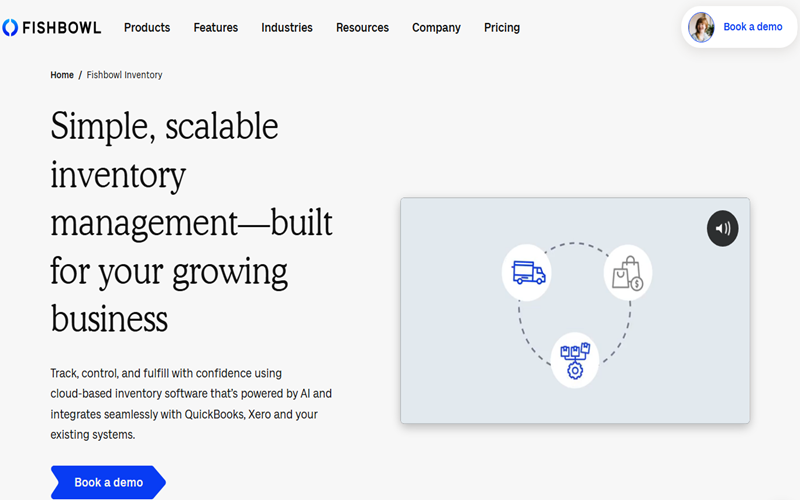
Fishbowl Inventory is an easy-to-use, AI-powered inventory management system, considered best for small- to mid-sized manufacturing businesses. This software relieves you of ERP complexity and provides a single platform to manage stock levels, orders, and delivery processes. You can use its on-premises or cloud-based system based on your business requirements.
Features
Real-time Visibility and Sales — Fishbowl Inventory helps you reduce surplus stock, move out slow sellers, and focus on items customers actually want. Similarly, the inventory system updates in real time with every sale, whether it happens within minutes, hours, or days. This helps you avoid stock shortages and deliver a better customer experience.
Bill of Materials (BOMs) — Another standout feature of this advanced platform is the seamless creation and customization of various manufacturing BOMs. It simplifies inventory handling by letting you add items, change quantities, upload visuals, and automate production orders. You can conveniently tailor notes for both raw and finished goods with this functionality.
Easy Integration — If you are fed up with managing large spreadsheets to track inventory and accounting data, Fishbowl is a great fit for you. It connects seamlessly with accounting tools like NetSuite, QuickBooks, and Xero to provide clearer operational insights. Correspondingly, you can effortlessly link Fishbowl with eCommerce platforms such as eBay, Shopify, and Amazon.
Multiple Device Support & Bar Code Scanning — Fishbowl Inventory is accessible on both desktop and mobile, allowing manufacturers to manage operations from anywhere. Besides, it handles inventory movement efficiently with barcode scanning, reducing the need for manual data entry.
Sync with Multiple Costing Methods — Fishbowl confers accurate costing by aligning inventory flows with FIFO, LIFO, and average cost methods. Hereof, it also provides detailed reporting to help businesses understand how different costing approaches influence profit.
Limitations
- Fishbowl Inventory may not be suitable for large-scale, complex manufacturers due to limited support for MRP and production planning.
- It has a great dependency on QuickBooks.
Pricing
Have a look at the different pricing models of Fishbowl Inventory:
Essentials: This plan costs $229 per month and supports 2 users. Monitoring inventory, SKU management, and cycle counts are its key features.
Growth: With additional AI Manufacturing and shipping tools support, this plan costs you $429/month. It is applicable for 5 users.
Scale: This advanced inventory-handling program charges $729/month for 10 users. Advanced AI capabilities, permission controls, and forecasting are its core properties.
Custom: If you are looking for a tailored plan for your business, this option is a great fit. It allows you to customize everything from payment processing to complex fulfillment workflows.
2. Katana MRP
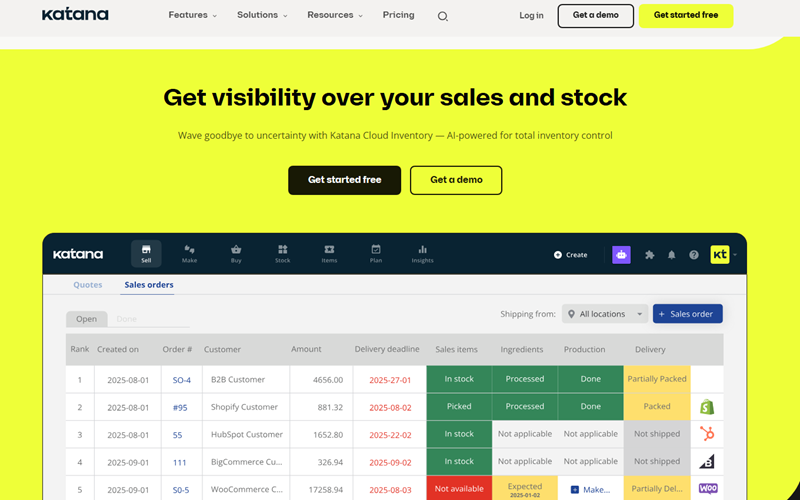
Katana MRP is a robust cloud-based inventory solution tailored for startups and growing D2C brands. With improved inventory turnover, Katana helps you monitor raw materials, in-process items, and finished goods while maintaining full manufacturing control. This dedicated platform reduces complexity by offering straightforward planning and clear visibility.
Features
Real-Time Stock Visibility and Tracking — Immediate inventory control helps businesses strike the right balance between overstock and stockouts. Hereof, Katana enhances inventory accuracy by using barcodes and serial numbers across multiple warehouse operations.
Bill of Materials (BOM) — Katana BOM suits both small and large-scale manufacturers by streamlining material demand calculations. Additional advantages include automatic cost calculation, smarter resource planning, and improved inventory control.
Easy Integrations — You can leverage Katana Open API to sync your inventory or BOM software with various CRM, accounting, shipping, eCommerce, and automation solutions. Yes, it is simple to integrate Katana MRP with HubSpot, QuickBooks, Xero, ShipStation, and Shopify.
MTS & MTO Workflows — This system lets you run both production strategies —make-to-stock and make-to-order —side by side without switching platforms. This functionality supports healthier cash flow, more balanced production, and lower waste levels.
Limitations
- Katana is a smart tool for inventory and small-scale production, but it is not built for enterprise-level manufacturing like NetSuite or Epicor.
- Lack of a mobile app and a steep learning curve are further drawbacks of using Katana MRP.
Pricing
Katana MRP offers two pricing structures to its users:
Free Plan: The Free Plan, which lets you use Katana without entering credit card details, is the best part of Katana. This no-cost program lets you use all Katana features for 15 days without restrictions. You can also manage up to 30 SKUs across three inventory locations.
Core Plan: The paid plan starts at $299 monthly, with no limits on SKUs, locations, integrations, or users. Additional features under this plan include onboarding, custom templates, multi-currency support, warehouse management, and inventory tracking across locations.
3. Odoo
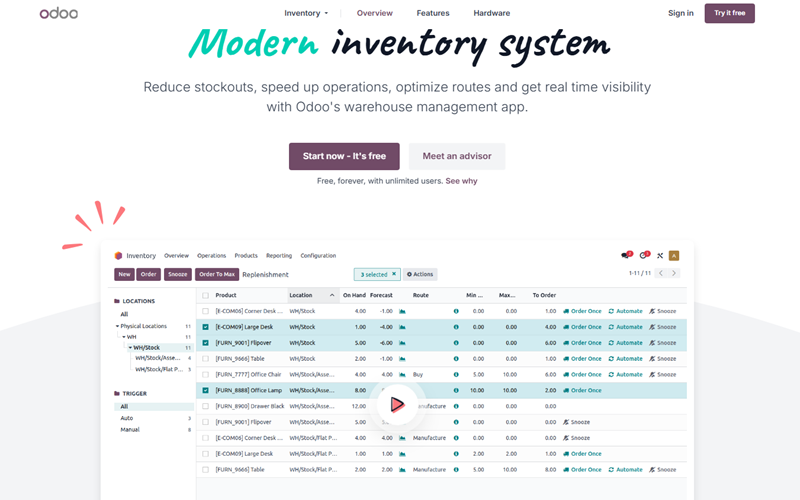
If you’re looking for an open-source, all-in-one solution to manage inventory, manufacturing, accounting, and point-of-sale operations, Odoo is worth considering. With no-cost entry, Odoo could be a great choice for mid-sized and small businesses operating on limited budgets and without in-house developers.
Features
Automated Inventory Management — Odoo utilizes various approaches, including production planning, MTO, and minimax parameters, to keep you on top of your inventory game. It also handles delivery reminders and purchase order confirmations to support just-in-time (JIT) vendor coordination.
Smart Warehouse Management — You can manage and track inventory instantly across locations using integrated tracking and analytics features. Some of these properties include KPIs, barcodes, serial numbers, and allocation methods.
Intelligent Picking Methods — Odoo uses smart picking strategies to boost production by up to 30% without increasing team size. Each method serves a purpose: wave picking for large warehouses, cluster picking for small orders, and batch picking for grouped fulfillment and sorting.
Quick Barcode Scanning & Costing Methods — This open-source platform supports GS1, EAN14, QR codes, and EAN13 barcode formats. In addition, the Odoo system is flexible enough for any setup, as it supports both periodic and perpetual inventory methods. Yes, you can proceed with different valuation methods, including LIFO, FIFO, and standard costing.
Seamless Integrations — Used by more than 15 million users globally, this inventory management app stands out for its seamless integrations and vendor-free lock-in. You can easily connect it with internal apps and external eCommerce, shipping, accounting, and logistics platforms.
Limitations
- Odoo may fall short in advanced scheduling, shop-floor management, and production control, mainly in complex manufacturing ecosystems.
- You would probably need third-party MES/APS tools or extra modules for high-end industrial setups while using Odoo.
Pricing
Let’s take a closer look at Odoo’s pricing plans:
One App Free: Odoo provides a free plan for life with access to one application and unlimited users.
Standard: This plan supports all applications and costs $7.25/user per month.
Custom: If you need multi-company support, on-premises hosting, Odoo Studio, and external API support, Custom is the right plan for you. It costs $10.90/user/month.
4. Cin7 Core
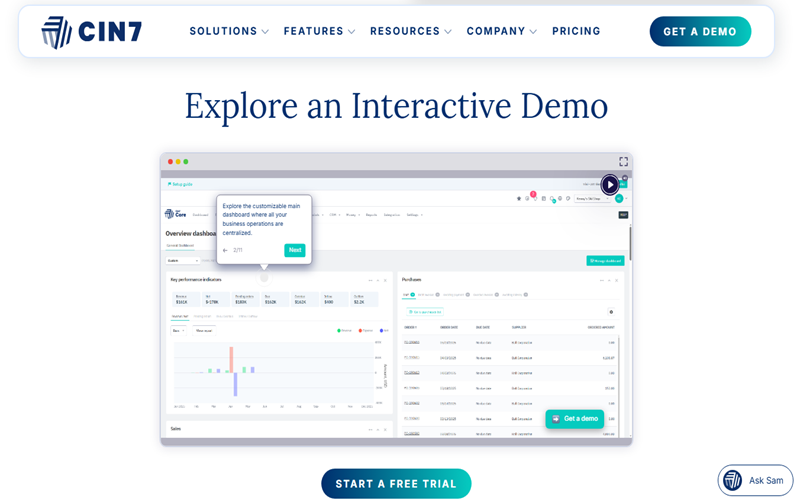
Cin7 Core is another dedicated cloud-based inventory system built for growing manufacturers, wholesalers, and eCommerce businesses. This highly scalable software streamlines every stage of the inventory process, from sourcing and storage to sales, billing, and replenishment. Besides, this platform integrates with 700+ third-party apps and delivers real-time inventory visibility.
Features
Connected Inventory Performance — This feature streamlines stock-handling workflows. You get fully automated workflows from procurement to manufacturing and finished goods. Similarly, when you sync your inventory software with multiple accounting, eCommerce, shipping, and marketing platforms, workflow becomes seamless.
ForesightAI — Cin7 Core depends on a powerful tool, ForesightAI, for forecasting. This system simplifies the demand prediction and inventory replenishment while reducing stock risks. ForesightAI helps businesses plan by predicting demand for the next 24 months.
Manufacturing BOMs — Like all other renowned inventory management systems, Cin7 Core also offers BOM functionality. However, BOMs in Cin7 Core not only outline components but also help manage and monitor production. They connect materials, costs, inventory, and production into a unified workflow.
Support for Mobile Devices — Cin7 works seamlessly across both mobile and desktop devices. This trait makes it easy for executives to monitor inventory and track stock levels from their smartphones anywhere in the world.
Limitations
- Users often complain about the poor customer service of Cin7 Core.
- The platform struggles in complex, highly automated, or compliance-driven manufacturing setups that demand tighter control.
Pricing
Manufacturing companies can choose from four pricing options in Cin7 Core. Let’s break them down.
Standard : This package works best for small manufacturing businesses. The plan starts at $349 per month for 5 users and supports an unlimited number of inventory locations.
Pro : You can employ this plan for growing and mid-sized businesses. It costs you $599/month for 10 users, material planning, 4 app integrations, and much more.
Advanced : Large enterprises can consider this model for complex manufacturing operations. It is priced at $999 per month for advanced warehouse operations, 15 users, and an annual sales volume of 120,000.
Omni : Big firms that want fully tailored inventory management solutions powered by AI can pick this program. The sales team can provide a quote based on your specific requirements.
5. inFlow Inventory
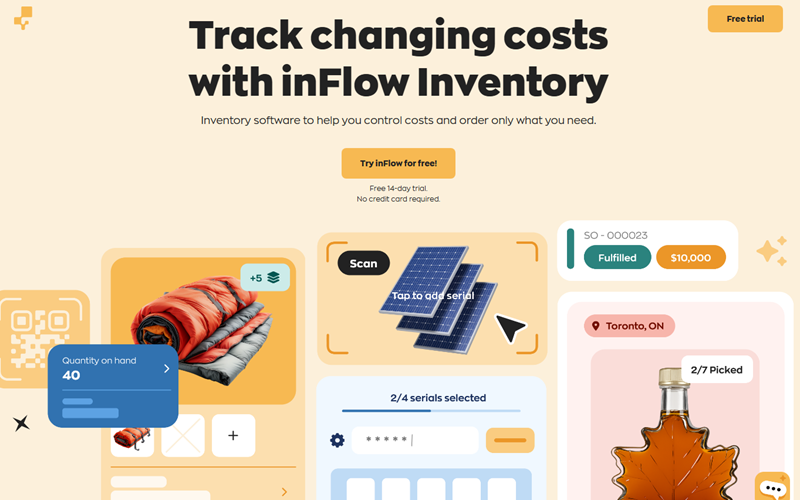
inFlow Inventory is a good fit if you are tired of expensive ERP systems or disorganized spreadsheets for stock management. This easy-to-use system is ideal for entrepreneurs, startups, and small teams of 50 people or fewer. Mainly, you get the best results when you align inFlow Inventory with inFlow Manufacturing software.
Features
Smart Management — Intelligent inventory management, tracking, and forecasting are key aspects of inFlow. This platform enables you to monitor stock in both virtual and physical warehouses and provide exact demand predictions. You can also use 3PL to track key customer-defined attributes, including serials, lots, and product variations.
Barcode Support — inFlow is highly compatible with barcode formats such as UPC, ISBN, and ISMN. It also uses advanced barcode printing and serialization approaches to save time and energy for managing stock.
Quick Integrations — Third-party integrations are smooth with inFlow. You can seamlessly sync your inventory software with 90+ accounting, POS, eCommerce, shipping, logistics, and payment systems.
BOM Support — inFlow Inventory streamlines manufacturing by using BOMs to calculate costs and automatically adjust stock levels during production orders. In addition, this software supports nested BOMs, enabling complex products to be built from subassemblies within a unified production process.
Limitations
- inFlow Inventory is ill-suited to advanced manufacturing due to weak shop-floor control, basic scheduling capabilities, and limited operational visibility.
- Small businesses often see it as an expensive solution to run.
Pricing
inFlow offers a 14-day free trial for new users, though it is fairly basic. Let’s take a look at its four pricing categories.
Entrepreneur : This package costs $129 per month when billed annually and includes support for 1,200 orders, 2 users, and 1 inventory location.
Small Business : Priced at $349 per month (annual billing), this plan includes unlimited location support, 12,000 sales orders, and is suitable for a team of 5 members.
Mid-Size : With a monthly price tag of $699, you get 10 users, 5 integrations, and no limits on sales or inventory locations.
Enterprise : This plan is a good choice for large-scale manufacturers who need support for 25+ users and advanced tracking features, such as lot and serial numbers. You can contact the sales team for further details.
Compare the Best Inventory Management Software
| Software | Best For | Free Plan | Starting Price | BOM & Manufacturing Support |
| Fishbowl Inventory | Small to mid manufacturers needing ERP-lite control | ❌ No | ~$229/month | Strong BOM + assembly + manufacturing orders |
| Katana MRP | D2C brands & growing product manufacturers | ✔ Yes (limited SKUs) | ~$299/month | Strong BOM + real-time production planning |
| Odoo | Flexible SMBs to mid-enterprise with custom needs | ✔ Yes (1 app free forever) | ~$7.25/user/month | Very strong (modular BOM, MRP, routing) |
| Cin7 Core | Growing manufacturers, wholesalers, eCommerce | ❌ No | ~$349/month | Strong BOM + production workflow integration |
| inFlow Inventory | Small manufacturers & startups | ❌ No | ~$129/month | Basic–moderate BOM + nested BOM support |
FAQs
What is the most suitable inventory software for small-scale manufacturing companies?
Small manufacturing units usually rely on simple, easy-to-set-up, cost-efficient solutions. In this regard, inFlow, Katana, Cin7 Core, and Odoo are popular because they balance manufacturing features with ease of use, making them suitable for different levels of production complexity.
What are the best free inventory management systems for manufacturers?
In our list, we highlighted two solutions with free plans. One is Odoo, and the second is Katana. Odoo’s no-cost offering is free forever, but Katana has a 15-day limit.
Should small companies use cloud-based inventory systems?
Yes, Cloud solutions are ideal for growing manufacturers as they are quick to implement, accessible anywhere, and provide live updates for inventory and production management. However, if you want more control, you should consider on-premises solutions.
Which software is best for manufacturing with BOM and production tracking?
Software like Katana, Cin7 Core, and inFlow are best for manufacturing with BOM and live production tracing.
Final Words
Finding inventory management software online is not rocket science. You just put a term on Google, ChatGPT, Claude, Bing, and see plenty of results. However, choosing the right option is tricky among too many solutions. That is why we listed one of the leading inventory software options for manufacturers, along with its core features, drawbacks, and updated pricing structure. This makes it easier to choose an option tailored to your needs.