


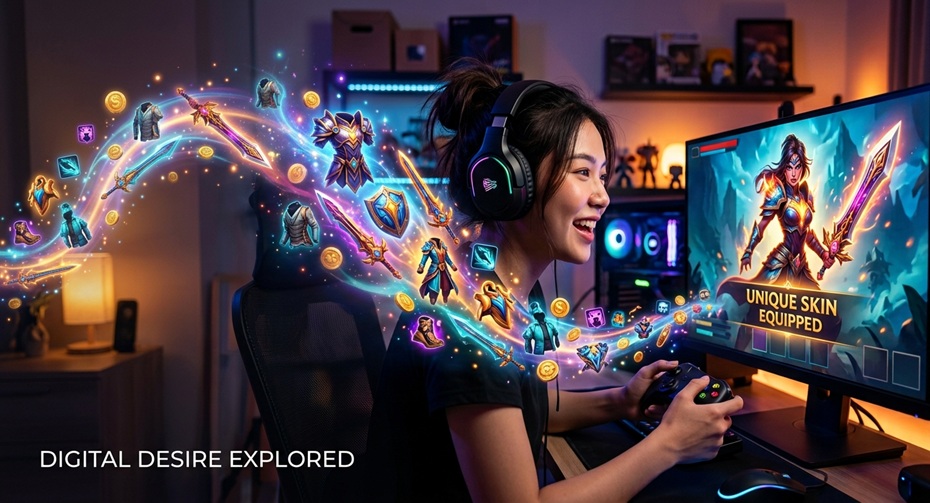
Buying a skin in a video game can look strange from the outside. You spend real money on an item that does not make your character stronger, unlock a new level, or necessarily change how you play. In many cases, the item only changes how a weapon, character, vehicle, or avatar looks.
Yet millions of players continue to buy them.
Some spend a few dollars on a new character outfit. Others regularly purchase cosmetic bundles, seasonal items, weapon finishes, emotes, or battle passes. A smaller group spends hundreds or even thousands of dollars chasing rare virtual items. In games with active player-driven markets, some individual skins become valuable enough to attract collectors, traders, investors, and professional marketplaces.
So, why do gamers spend real money on skins?
The answer is more complicated than simply saying players want their characters to look better. Skins sit at the intersection of psychology, identity, social status, scarcity, collecting, entertainment, nostalgia, competition, and increasingly sophisticated digital economies.
Gaming itself has also changed. Players no longer simply buy a game, finish it, and move on to something else. Live-service games can become long-term social spaces where people spend hundreds or thousands of hours. Their avatars, inventories, profiles, achievements, and cosmetic collections become part of their digital identity.
That changes how players perceive virtual items.
A skin can become a way to stand out, commemorate a particular period, signal expertise, show membership in a community, or simply make a familiar game feel fresh again. In some markets, it can even become an asset with a recognizable monetary value.
The psychology behind that behavior reveals something much bigger about modern gaming. Let’s explore these reasons one by one:
1. Skins Are No Longer Just Cosmetic Extras
The traditional idea of a video game cosmetic is simple. A developer creates an alternative appearance for a character or weapon, and players can purchase it if they like the design.
That description still applies, but it misses what skins have become.
Modern multiplayer games are persistent environments. Players return to the same game for months or years. They meet friends there, watch creators play it, follow professional tournaments, discuss updates, and build communities around specific characters and items.
Because players spend so much time in these environments, visual customization becomes more meaningful.
Imagine using the same character or weapon for several hundred hours. Eventually, the default appearance can feel ordinary. A new skin introduces a small change without requiring the player to learn a new game or mechanic. It creates a feeling of novelty inside a familiar environment.
That is one reason cosmetic monetization works so well.
The player does not necessarily buy functionality. They buy a new emotional experience around something they already enjoy.
Research into gaming monetization increasingly examines how cosmetic purchases interact with scarcity, social influence, enjoyment, perceived value, and other psychological mechanisms. Recent research on game spending also highlights how design elements such as virtual currencies, limited availability, social pressure, and scarcity can influence purchasing behavior.
The important point is that a skin’s value does not have to come from gameplay power.
It can come from what the item represents.
2. Players Use Skins to Express Identity
One of the strongest reasons people buy skins is identity.
People customize almost everything they consider an extension of themselves. They choose clothes, shoes, phones, cars, furniture, accessories, profile pictures, and hairstyles based partly on personal taste.
Digital spaces are not fundamentally different.
When someone chooses a particular character skin, weapon finish, avatar, banner, animation, or cosmetic bundle, they are making a visual statement. They are deciding how they want other players to see them.
The choice can be subtle.
A player might prefer minimal designs because they dislike flashy cosmetics. Another might choose the most colorful skin available. Someone else may want a skin associated with a favorite professional player or esports team. A collector might deliberately build an inventory around a particular theme.
None of these decisions affect the core gameplay, but they still communicate something.
This becomes especially powerful in games where players see each other constantly. In a single-player game, a cosmetic can mainly exist for personal enjoyment. In a competitive multiplayer game, other people become part of the experience.
Your skin becomes visible.
That visibility gives cosmetic items social meaning.
3. Personalization Makes Digital Worlds Feel More Personal
Customization also changes the emotional relationship players have with a game.
A default character belongs to everyone. A personalized character feels more like yours.
This distinction matters because ownership and personalization can increase emotional attachment. When players spend time choosing cosmetics, organizing inventories, and creating a particular visual style, the game begins to feel less generic.
The same principle exists outside gaming.
People customize their smartphones with wallpapers and cases. They personalize computers with accessories and desktop setups. They choose clothing that reflects their personality. Even discussions around MacBooks for Gaming increasingly extend beyond raw hardware performance into design, portability, ecosystem, and the way technology fits someone’s lifestyle.
Skins operate on a similar psychological principle.
They allow players to personalize an otherwise standardized digital environment.
That personalization can make returning to the game more enjoyable because the player is not simply entering a game world. They are entering a space that contains something they have shaped.
4. Scarcity Makes Ordinary Items Feel Extraordinary
Scarcity is one of the oldest forces in human purchasing behavior.
If something is unlimited and always available, people tend to perceive it differently from something that may disappear tomorrow.
Gaming developers understand this extremely well.
A skin described as “available for a limited time” immediately feels different from one that can be purchased whenever the player wants. The design may be identical in quality, but its perceived value changes because access is uncertain.
This is where scarcity becomes powerful.
Players start thinking about future availability rather than present usefulness. They may ask themselves whether they will regret missing the item. That question shifts the decision from “Do I want this?” to “Will I wish I had bought this?”
That is a much stronger psychological trigger.
The effect becomes even more interesting when scarcity combines with community attention. If everyone is talking about an item and it is disappearing soon, the player does not simply see a cosmetic. They see an opportunity that might not return.
In markets such as CS2, scarcity can become even more complicated because supply, item characteristics, market demand, and collector behavior interact. Research and market analysis around Counter-Strike’s skin economy show how rarity, float values, patterns, stickers, and player demand can contribute to substantial price differences between items that serve essentially the same gameplay function.
The psychological lesson is straightforward.
People do not always value things according to their practical usefulness. Sometimes they value them because they are difficult to obtain.
5. Rarity Creates Digital Status
Rare items can also function as status symbols.
A player carrying an unusual or expensive skin can communicate something without saying a word. Other players may recognize the item and understand that it is difficult or expensive to obtain.
That recognition creates social value.
This is particularly obvious in games with mature cosmetic economies. A common skin may be visually attractive, but an extremely rare item can carry additional meaning because people know its history, availability, or market value.
In this environment, the skin becomes a signal.
It can suggest experience, dedication, wealth, taste, knowledge, or simply long-term involvement with the game.
This is similar to how luxury goods work in the physical world. A luxury watch tells a story that goes beyond telling time. A rare sneaker can communicate knowledge of a particular culture. A collectible card can signal membership in a community.
Digital cosmetics can do something similar.
The difference is that their environment is virtual.
6. The Brain Loves Collection and Completion
Another major factor is the psychology of collecting.
People naturally enjoy completing sets. Once a player owns several items from a particular collection, getting another one can feel more satisfying than buying a completely unrelated cosmetic.
This creates a progression loop.
One skin becomes three. Three become ten. Eventually, the collection itself becomes valuable to the owner even if the individual items are not particularly expensive.
The player may begin organizing an inventory around themes, characters, weapons, colors, events, or historical releases.
At this stage, the purchase is no longer simply about appearance.
It is about completion.
Collectors understand this feeling well. The final missing piece can become disproportionately important because it completes the larger picture.
Game developers can reinforce this behavior through collections, sets, tiers, seasonal rewards, achievement systems, and limited releases.
The result is an ecosystem where collecting itself becomes part of the entertainment.
7. FOMO Can Turn Desire Into Urgency
Fear of missing out, commonly called FOMO, plays a major role in digital purchasing.
A player might initially have no intention of buying a skin. Then they see a countdown, a limited bundle, a creator using the item, or other players discussing it.
Suddenly, the purchase feels urgent.
FOMO works because it changes the emotional cost of waiting.
Without scarcity, waiting costs almost nothing. The item will still be available next week. With scarcity, waiting creates uncertainty.
The player begins imagining the future without the item.
This is particularly effective in live-service games because developers can constantly refresh the store. New cosmetics appear, old ones disappear, and seasonal events create natural purchasing windows.
Research into gaming monetization has identified scarcity and other design elements as important features in discussions of potentially problematic spending mechanics. That does not mean every cosmetic purchase is harmful, but it does explain why certain systems can create unusually strong purchasing pressure.
The healthiest approach for players is to recognize the difference between wanting something and feeling pressured to buy it immediately.
8. Social Influence Makes Skins More Desirable
Humans rarely make purchasing decisions in isolation.
What other people value influences what we value.
Gaming communities make this especially obvious because players constantly see cosmetics through streams, tournaments, YouTube videos, social media posts, Discord communities, and in-game encounters.
A skin can become desirable because everyone starts talking about it.
This creates a social feedback loop.
One player buys a cosmetic. A streamer showcases it. Viewers become interested. More players buy it. The skin becomes more visible. Its visibility makes it feel more important. That attention generates even more demand.
The cycle can happen quickly.
Peer validation also matters. Players may not consciously think, “I need other people to approve this purchase.” Instead, they may simply feel that the item looks better because they see respected players using it.
Recent research examining cosmetic purchases in games has explored factors such as aesthetic appeal, scarcity, enjoyment, competitive perceptions, and peer validation expectancy, showing how purchasing decisions can extend beyond simple visual preference.
This is why a skin’s popularity can sometimes matter almost as much as its design.
9. Streamers and Esports Turn Cosmetics Into Culture
Content creators have changed the role of gaming skins.
A streamer can turn a cosmetic into a recognizable part of their identity. Viewers begin associating a particular skin with that creator.
Professional esports can have a similar effect.
When millions of viewers watch a tournament, they see the weapons, characters, team branding, and cosmetic items used by professionals. These visuals become part of the culture surrounding the game.
The skin is no longer just an item in an inventory.
It becomes part of the story.
A particular item might remind fans of a famous tournament, a legendary player, a major upset, or a specific era of competitive gaming.
That historical association can increase emotional value.
This is one reason digital items can become collectibles even when they have no functional advantage.
Their meaning changes over time.
10. Why CS2 Is One of the Best Examples of Digital Desire
Counter-Strike 2 provides one of the clearest examples of how gaming cosmetics can develop into a sophisticated digital economy.
The game’s skins are not simply cosmetic decorations sitting inside a closed inventory. Depending on the item and marketplace involved, players can encounter rarity, float values, pattern variations, stickers, trading activity, price fluctuations, and different forms of market access.
That creates a much deeper relationship between player psychology and digital value.
The CS2 market has become large enough to attract serious economic analysis. Industry reporting in 2026 describes it as a multi-billion-dollar ecosystem, although estimates vary depending on whether researchers measure inventory value, transaction volume, market capitalization, or other metrics.
This distinction matters.
A skin can be valuable because a player likes it. It can also be valuable because other people want it. Those two forms of value can overlap, but they are not identical.
11. Why Rare CS2 Items Can Become So Valuable
The phrase rare CS2 items covers a wide range of cosmetics, but the underlying principle is scarcity combined with demand.
Two skins can perform exactly the same gameplay function while having dramatically different prices.
Why?
Because their visual characteristics, availability, float values, patterns, stickers, age, and perceived desirability can differ.
Some collectors care about extremely specific combinations of characteristics. That creates a market where small differences can have large financial consequences.
This is similar to physical collectibles.
A mass-produced object can become valuable when a particular version becomes difficult to find or historically important. In CS2, digital characteristics create comparable distinctions.
The result is a fascinating contradiction.
The item has no competitive utility, yet players can assign significant monetary value to it.
That value comes from collective belief.
If enough participants agree that an item is desirable and scarce, the market can establish a price.
12. Even MAG-7 Skins in CS2 Can Matter
A good example of this principle is the market for MAG-7 Skins in CS2.
The MAG-7 is not the first weapon most people associate with expensive Counter-Strike cosmetics. That is precisely what makes it interesting.
Players do not necessarily buy a skin because the weapon is the most powerful or popular option. They may buy it because they enjoy the design, collect skins for specific weapons, want a matching inventory, or simply like using an unusual item.
That demonstrates an important truth about cosmetic economies.
Demand does not always follow competitive importance.
A cosmetic can become valuable because of aesthetics, nostalgia, rarity, collection goals, or personal attachment.
The emotional connection can be enough.
13. Skins Can Carry Memories
One of the most overlooked reasons players keep digital cosmetics is nostalgia.
A skin can remind someone of a particular period in their life.
Maybe they bought it when they started university. Maybe they used it while playing with friends every evening. Maybe they won a memorable match while using it. Perhaps a particular skin reminds them of a tournament they watched years ago.
The item becomes a digital souvenir.
Its monetary price may be irrelevant to the owner.
This explains why some players refuse to sell cosmetics even when market prices rise. The item has acquired personal meaning that cannot be measured by its current market value.
Digital objects can therefore become containers for memories.
That is a major development in gaming culture.
14. Cosmetics Make Familiar Gameplay Feel New
Games eventually become familiar.
A player learns the maps, mechanics, weapons, characters, strategies, and rhythms. The novelty that existed during the first few hours naturally declines.
Cosmetics offer a small way to refresh that experience.
Changing a character’s appearance can make an old game feel slightly different. Using a new weapon skin can make a familiar loadout feel more interesting.
This is a relatively inexpensive way for developers to extend engagement while giving players something new to explore.
For the player, the purchase can function almost like buying a new accessory for an existing hobby.
You are not buying a new game.
You are refreshing the experience you already enjoy.
15. Fixed-Price Skins Feel Different From Loot Boxes
Not all cosmetic systems create the same psychological experience.
A fixed-price skin tells the player exactly what they are buying. The player sees the item, sees the price, and makes a decision.
Loot boxes and randomized rewards introduce uncertainty.
That uncertainty can create a different emotional dynamic because the player does not know exactly what they will receive.
The anticipation becomes part of the experience.
Research into loot-box design has identified numerous features related to rarity, virtual currencies, cosmetic rewards, value manipulation, social influence, and resemblance to gambling mechanics.
That does not mean every randomized cosmetic system is equivalent to gambling. The legal and psychological definitions vary by system and jurisdiction.
However, the comparison is important because uncertainty can encourage repeated attempts in a way that a straightforward purchase does not.
A player who buys a $20 skin knows what they are getting.
A player spending $20 on randomized opportunities may be motivated partly by what could happen next.
Those are very different purchasing experiences.
16. The Psychology of “One More Try”
The phrase “one more try” is powerful in gaming.
It can apply to a difficult boss, a competitive match, a loot box, or a marketplace purchase.
When randomized rewards are involved, each attempt can create anticipation. A disappointing result may encourage another attempt because the desired outcome still feels close.
This is where monetization design deserves careful attention.
Players are not simply rational consumers comparing prices and utility. Emotion, anticipation, disappointment, social pressure, and perceived scarcity can all influence decisions.
The broader gaming industry is increasingly studying these mechanics because spending patterns can vary dramatically between ordinary players and a small group of very high spenders. Recent research has examined expenditure disparities and the relationship between microtransactions, gaming disorder, and gambling-related behaviors, particularly among younger players.
For players, understanding these mechanics creates an advantage.
You can enjoy cosmetics without allowing the purchasing system to dictate your behavior.
17. Battle Passes Changed the Spending Equation
The battle pass introduced another major shift in gaming monetization.
Instead of buying one cosmetic at a time, players can purchase access to a progression track filled with rewards.
The psychology changes because the purchase becomes connected to time and activity.
A player may think, “I already bought the pass, so I should finish it.”
That creates an incentive to keep playing.
The rewards also arrive gradually, which can make the purchase feel more substantial than receiving one cosmetic immediately.
Battle passes can therefore combine entertainment, progression, collection, and spending into a single system.
For developers, this creates recurring revenue.
For players, it can make cosmetic spending feel more like participation in a seasonal event.
The distinction between playing and shopping becomes less obvious.
18. Players Sometimes Pay for Convenience, Not Status
Not every cosmetic purchase is about impressing other people.
Sometimes the motivation is convenience.
A player may want a cleaner interface, a favorite character design, a better-looking weapon, or an item that makes their experience more enjoyable.
They may simply have disposable entertainment money and decide that a particular cosmetic is worth the price.
This is important because discussions about skins can become overly cynical.
Not every player is being manipulated.
People spend money on hobbies because hobbies provide enjoyment. A person can spend $30 on a restaurant meal, a movie, a collectible, a sports jersey, or a game cosmetic.
The underlying question is not whether the item has physical utility.
The question is whether the buyer considers the experience worth the price.
19. Digital Luxury Is Becoming a Real Gaming Concept
Luxury depends heavily on perception.
A luxury product often performs the same basic function as a cheaper alternative, but its value comes from craftsmanship, scarcity, branding, history, social meaning, or exclusivity.
Gaming skins can follow the same pattern.
A basic cosmetic can provide visual customization. A rare cosmetic can provide customization plus scarcity and status.
That additional meaning creates a form of digital luxury.
The concept becomes especially interesting as younger generations spend more of their social time online. If people increasingly socialize, compete, create content, and build identities inside digital environments, then digital appearance naturally becomes more important.
The luxury market does not necessarily need physical objects.
It needs objects people care about.
The New Economics of Skin Trading in 2026
Gaming skin economies are also becoming more economically sophisticated.
Players now encounter marketplaces, pricing tools, historical data, inventory trackers, trading communities, rental models, and increasingly complex forms of digital access.
Academic research published in 2026 has even examined CS2 skin rentals, exploring how temporary access rights affect pricing and market behavior.
That is an important development.
For years, the assumption was that a player either owned a cosmetic or did not own it.
Rental models challenge that idea.
They introduce another possibility: access can itself have value.
A player might want to use an expensive cosmetic for a short period without paying the full ownership price. That could eventually influence how developers and marketplaces think about digital goods.
The broader lesson is that gaming economies continue to evolve.
Skins are not simply decorative files anymore. In some ecosystems, they form part of complex networks involving ownership, access, scarcity, trading, and social status.
Why Liquidity and Market Access Matter
A digital item can have a high theoretical value without being easy to sell.
This distinction is critical.
A marketplace price does not automatically mean every owner can immediately convert an item into cash at that price. Fees, platform rules, buyer demand, listing depth, withdrawal restrictions, and market fragmentation can all affect liquidity.
The CS2 economy provides a clear example.
Steam Wallet funds, for instance, do not function exactly like cash in a bank account. Players can have substantial value inside a gaming ecosystem while facing restrictions on how that value can be used or withdrawn.
This creates what some market analysts describe as a liquidity trap.
The item can be valuable inside the ecosystem while remaining difficult to convert into traditional money.
That is why players should distinguish between market price, sale price, and real-world liquidity.
The difference becomes particularly important when people start treating skins like financial assets.
Skins Are Not Traditional Investments
The existence of a market does not automatically make a skin a safe investment.
Digital cosmetics can experience major price changes.
Demand can disappear. Developers can change item systems. Trading policies can change. New supply can enter the market. Player interest can move to another game.
A game can also lose popularity.
This means a skin’s value depends heavily on the health of the ecosystem surrounding it.
Traditional financial assets have established regulatory frameworks, disclosures, and market structures. Gaming cosmetics generally do not offer the same protections.
Players who purchase skins should therefore think about them primarily as entertainment or collectibles unless they fully understand the risks involved in treating them as speculative assets.
The fact that an item increased in value yesterday does not guarantee that it will do the same tomorrow.
Valuable Inventories Also Attract Scammers
As skin economies become more valuable, they naturally attract bad actors.
A valuable digital inventory can become a target for phishing, account theft, fraudulent trades, fake marketplaces, malware, and social engineering.
This is not theoretical.
Recent research into cybercrime in gaming has highlighted digital item theft as an important motivation for attacks and has examined how trading and tournament systems can create risky interactions between players.
The more valuable digital inventories become, the more attractive they become to attackers.
Players should therefore treat gaming accounts seriously.
Using strong authentication, avoiding suspicious links, checking trade details carefully, and refusing to share login credentials are basic but important precautions.
A skin may be virtual, but losing it can create a very real financial loss.
AI and Data Are Changing Skin Markets
Artificial intelligence is likely to influence gaming economies in ways that go beyond game development.
As marketplaces generate enormous amounts of pricing and transaction data, analytical tools can help players understand historical trends, price differences, demand patterns, and inventory characteristics.
AI can potentially make this information easier to interpret.
Instead of manually comparing hundreds of listings, players may eventually use intelligent systems to identify unusual pricing, compare similar items, estimate relative rarity, and understand market movement.
That does not eliminate risk.
It simply makes information easier to access.
The same technology can also help developers understand which cosmetics perform well, how players respond to pricing, and which visual styles generate demand.
This could make future cosmetic economies even more data-driven.
Developers Are Learning That Cosmetics Can Build Long-Term Engagement
The success of skins has changed how developers think about monetization.
In older gaming models, revenue often depended heavily on selling the initial game.
Modern live-service games can generate recurring revenue through expansions, subscriptions, battle passes, cosmetics, events, and other digital content.
Cosmetics are particularly attractive because they do not necessarily disrupt competitive balance.
A developer can sell a visual item without giving one player a direct gameplay advantage.
That creates an important distinction between cosmetic monetization and pay-to-win systems.
When designed responsibly, cosmetics can provide revenue while preserving competitive integrity.
The challenge is maintaining that balance.
If developers rely too heavily on artificial scarcity, randomized rewards, aggressive FOMO, or manipulative pricing structures, players may eventually feel that the game is designed around spending rather than entertainment.
The Future of Skins Will Be More Social
The next generation of skins is likely to become more interactive.
Instead of simply changing colors or textures, future cosmetics can react to player achievements, match statistics, events, social interactions, or progression.
Imagine a weapon cosmetic that evolves after a player reaches a milestone.
Imagine an avatar that visually changes based on achievements.
Imagine cosmetics that connect to esports events or creator communities.
These systems can increase emotional value because the item becomes more personal.
It is no longer just something the player purchased.
It becomes something they developed.
That distinction could make future cosmetics significantly more meaningful.
Gaming Skins Are Becoming Part of Digital Identity
The deeper trend is not really about skins.
It is about digital identity.
As more social interaction moves online, people increasingly need ways to represent themselves visually.
Avatars, profile images, usernames, cosmetics, achievements, and inventories all contribute to that identity.
A skin can therefore become a small piece of someone’s digital self.
That helps explain why players sometimes care about cosmetics far more than an outsider would expect.
The outsider sees pixels.
The player sees personality, memories, community, status, taste, and history.
That difference explains much of the economics.
Why Do Gamers Spend Real Money on Skins?
Ultimately, there is no single answer.
Gamers spend real money on skins because skins satisfy several psychological needs at the same time.
They provide personalization. They create novelty. They communicate identity. They can signal status. They satisfy collectors. They preserve memories. They create social belonging. They can generate excitement through scarcity and anticipation. In some games, they can also provide access to a sophisticated marketplace where rarity and demand create measurable monetary value.
The strongest cosmetic systems combine several of these factors.
A player might buy a skin because it looks good. They might keep it because it reminds them of a favorite period in their gaming life. Other players might recognize it as rare. A streamer might make it popular. Scarcity might increase demand. Market activity might give it a recognizable price.
Suddenly, the item has far more meaning than its visual appearance suggests.
That is the psychology of digital desire.
Are Gaming Skins Becoming More Important in 2026?
Yes, but not simply because players are spending more money.
The bigger change is that the relationship between players and digital objects is becoming more sophisticated.
Games are becoming social platforms. Communities are becoming more persistent. Esports and creators are shaping taste. Marketplaces are becoming more complex. Developers are experimenting with new ways to sell and distribute cosmetics.
At the same time, researchers and regulators are paying closer attention to monetization systems, especially where scarcity, randomized rewards, gambling-like mechanics, or younger audiences are involved. A UK government evidence review on skins gambling, for example, examined the relationship between skins, gambling-related activity, and potential risks.
This does not mean the future of gaming cosmetics is negative.
It means the industry is entering a more mature phase.
Players are becoming more aware of how digital economies work. Developers are learning which monetization strategies build trust and which create backlash. Marketplaces are becoming more transparent in some areas while becoming more complex in others.
The result is likely to be a gaming economy where digital items carry increasingly sophisticated forms of value.
The Real Reason Players Buy Virtual Items
The easiest way to understand skins is to stop asking what they do.
Ask what they mean.
A skin does not need to improve aim, increase health, or unlock a new ability to have value. Its purpose can be emotional and social rather than functional.
- It can make a player feel different.
- Gaming item can make an old game feel new.
- It can make a character feel personal.
- These can remind someone of a great match.
- It can signal membership in a community.
- It can represent years of involvement with a game.
- And sometimes, it can simply look fantastic.
That is enough.
The gaming industry has discovered that players do not only want to play digital worlds. They want to personalize them, collect pieces of them, remember them, and sometimes even build identities inside them.
Final Words
So, why do gamers spend real money on skins?
Because digital value is no longer limited to practical function.
Players spend money on skins for the same broad reasons people have always spent money on things they love. They want beauty, identity, recognition, novelty, belonging, memories, and a sense of ownership.
The difference is that those experiences now happen inside digital spaces.
A rare CS2 item can become a collector’s trophy. A character skin can become part of a player’s identity. A favorite cosmetic can bring back memories from years of playing with friends. A limited release can create urgency. A streamer can turn an ordinary item into a cultural symbol.
None of this means every skin deserves its price tag.
It means the price of a digital item cannot always be explained by its pixels or gameplay function.
The real value often exists in the psychology surrounding it.
As gaming continues to move toward persistent worlds, social communities, creator-driven culture, esports, digital marketplaces, and personalized experiences, skins will likely become even more important.
The future of gaming cosmetics is therefore not really about selling better textures.
It is about selling meaning.
And once players attach meaning to a digital object, spending real money on it suddenly becomes much easier to understand.
