

Russia continues to tighten its internet restrictions. In the fourth quarter of 2026, Roskomnadzor intensified restrictions on VPN services, targeting many major providers available in Russia. Moreover, Russian technology and cybersecurity journalist Maria Kolomychenko reports that Roskomnadzor aims to restrict access to nearly 92% of VPN services by the end of 2030.
Although some VPNs still work in Russia, staying connected has become a constant cat-and-mouse game. Many VPNs struggle to maintain reliable connections in Moscow because of deep packet inspection (DPI), TSPU filtering, and protocol blocking. Similarly, strict censorship across mobile networks, home routers, and internet providers, combined with allowlisting measures, makes it difficult for many VPNs to work in Russia.
As traditional VPNs become less reliable in Russia, more users are turning to DigitalCruch for dependable VPN alternatives. So we put together this comprehensive guide after in-depth research and hands-on testing.
5 Best VPN Alternatives That Actually Work in Russia
Let us explore some of the most advanced censorship-circumvention tools that go beyond traditional VPNs, examining their essential features, advantages, and limitations.
1. AmneziaWG
AmneziaWG is a powerful VPN protocol that relies on WireGuard’s encrypted tunnelling. With a 63% success rate in Russia-based tests, this self-hosted VPN solution stands out as a promising alternative when conventional VPNs fail in Moscow. AmneziaWG 3.1 further improves traffic obfuscation, making VPN connections harder to identify through deep packet inspection (DPI).
These enhancements make it a noteworthy option for Russian users facing increasingly sophisticated internet restrictions.
AmneziaWG has great compatibility with iOS, macOS and Android devices. You can also download it for Windows from GitHub.

How AmneziaWG Works?
If we talk about how it works, AmneziaWG keeps WireGuard’s established security architecture intact. However, it makes a few changes to disguise WireGuard traffic from DPI-based detection systems. Likewise, this VPN protocol adds randomness to packet sizes, alters detectable packet headers and transmits additional packets while connected.
Does AmneziaWG Actually Work in Russia? Real-World Testing Results
We divided the real-world testing results of AmneziaWG in Russia into 3 sections:
Mobile Network Testing
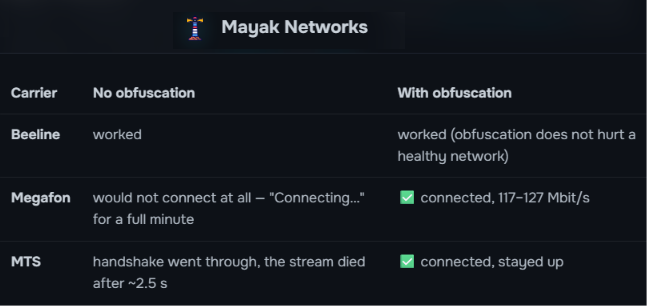
First, actual testing of AmneziaWG across multiple Russian mobile networks shows mixed results. For a closer look at its real-world performance, consider Mayak Networks’ Moscow testing report from July 2026.
This test signifies that AmneziaWG offers stable connectivity for MegaFon and MTS. In particular, delivering 117–127 Mbps on MegaFon is a major feature. However, these findings reflect only the networks tested in Moscow and should not be extrapolated to mobile carrier performance across Russia.
Connection Success Rate
Next, you’ll likely ask how successfully AmneziaWG connects you to the open internet, and here are the real stats. According to a recent investigative report by KRAKOBIT, AmneziaWG established connections in about 63% of recorded attempts, while the remaining 37% failed.
Under Simulated Russian DPI and Filtering Conditions
Russian internet users also need reliable tools to navigate Roskomnadzor’s increasingly sophisticated network filtering systems. That is why it is essential to examine how circumvention tools bypass these filtering systems. To that end, KRAKOBIT conducted controlled laboratory tests to evaluate AmneziaWG’s ability to withstand Russian-style DPI and network filtering mechanisms.
Nevertheless, these findings reflect performance under specific testing conditions, not nationwide results from across Russia.
Limitations of AmneziaWG
- AmneziaWG and Amnezia’s self-hosted system don’t work like traditional VPNs. You must have technical knowledge to set up this circumvention tool smoothly. It also depends on compatible software running on the user’s device and the remote server.
- It cannot guarantee connectivity under strict network allowlisting, and traffic obfuscation may add performance overhead.
2. VLESS + REALITY
VLESS + REALITY is an emerging proxy-based connection method gaining traction as an alternative to conventional VPNs in heavily censored regions like Russia. The setup uses proxy technology to make its traffic appear more like regular encrypted internet communications. This combination also complicates regulators’ efforts to detect and block its traffic through deep packet inspection (DPI).
When it comes to compatibility, this VPN alternative supports several operating systems, including Windows, iOS, Android, and Linux. However, operating system compatibility alone is not enough. You also need a compatible client, such as v2rayN, NekoRay, or Hiddify, to import and run the VLESS + REALITY configuration.

How Does VLESS + REALITY Actually Work?
VLESS + REALITY connects an Xray-compatible client to a remote server. Hereof, this combo uses a TLS-like handshake to make traffic harder to identify through deep packet inspection and active probing. After authentication, VLESS sets up a proxy tunnel that carries user traffic through the remote server to the requested online destinations.
Despite these protections, internet providers can still monitor the server IP, connection patterns, timing, and traffic volume.
Does VLESS + REALITY Actually Work in Russia? Real-World Testing Results
Now, Russian users may be wondering whether VLESS + REALITY actually works in the Kremlin-controlled internet environment. To answer that question, we have gathered statistical data and experimental results to examine how well it performs.
First of all, we would like to mention the results of a recent censorship emulation experiment conducted by KRAKOBIT using 8 protocols. The results showed that VLESS + REALITY withstood simulated network filtering mechanisms.
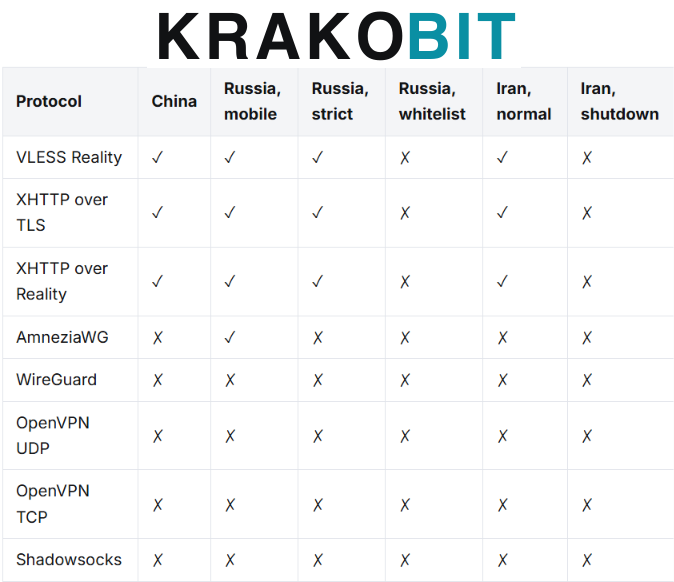
However, this was only a controlled-environment experiment, not a comprehensive nationwide assessment across multiple mobile networks.
Moving beyond simulated experiments, let us examine a real-world connection test conducted by HopFox VPN. According to HopFox VPN’s test results, VLESS + REALITY established successful connections in approximately 59% of recorded attempts, while the remaining 41% failed.
Limitations
The major drawback of this proxy-based setup is the absence of guaranteed DPI resistance. Yes, Russian ISPs can still recognize your server IPs and unusual traffic patterns.
You also need some technical knowledge to configure an Xray-compatible client, troubleshoot errors, or handle future updates.
3. Hysteria2
If you want a blazing-fast, open-source, censorship-resistant proxy alternative to VPNs in Russia, Hysteria2 is a strong option. This promising tool uses QUIC to carry traffic instead of WireGuard and OpenVPN. By mimicking ordinary HTTP/3 traffic, the protocol makes it harder for censorship systems to detect. Blocking it could also affect legitimate services.
As for compatibility, Hysteria2 supports multiple routers, Windows, Android, iOS, Linux, and macOS.

How does Hysteria2 work?
Hysteria2 utilizes a client-server architecture to establish an encrypted QUIC connection over UDP, routing users’ internet traffic through a remote server. Additionally, Salamander obfuscation and website masquerading help disguise proxy traffic and reduce the chances of easy detection.
Despite these obfuscation techniques, Russian network filters may still detect the traffic or block the server’s IP address.
Real-world Testing Results of Hysteria2
It is also important to know how effectively Hysteria2 works in a Russian-censored internet environment. In this regard, we are presenting 2 available tests for our readers.
The first experiment does not test Hysteria2 directly, but its findings remain relevant because they examine QUIC Salamander, a key component of Hysteria2’s traffic obfuscation. TiredVPN’s Availability Report on GitHub says QUIC Salamander successfully connects across Rostelecom and MegaFon networks.
| Russian network | Exit node A | Exit node N |
| Rostelecom | 125 ms | 88 ms |
| MegaFon | 133 ms | 119 ms |
Screenshots of tests are also attached below.
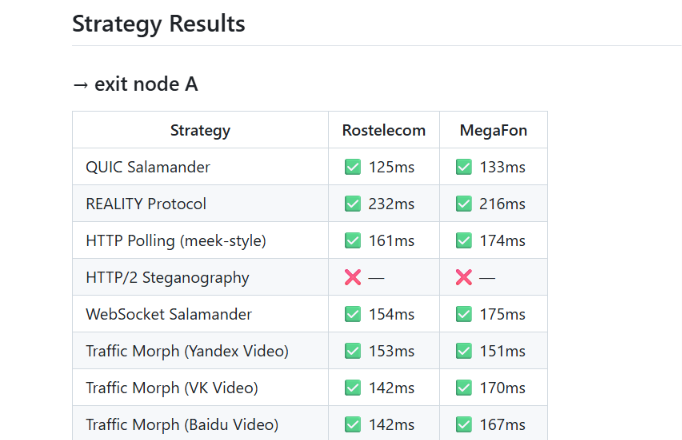
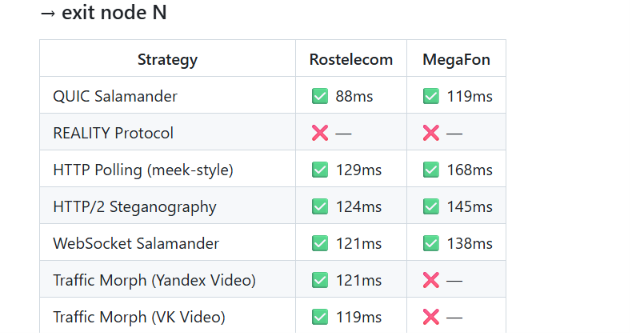
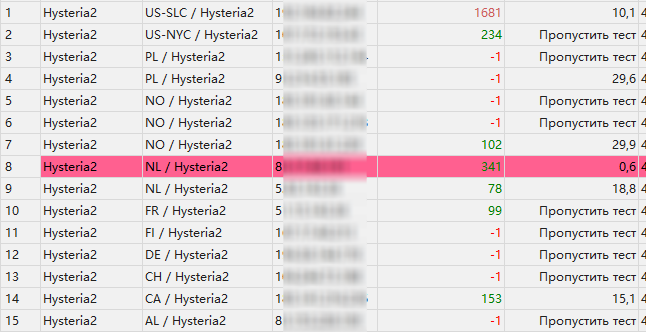
Similarly, we are also sharing a report from a Siberian user shared on the Xeovo community forum. According to him, 120 out of 298 Hysteria2 proxy endpoints remained reachable following another round of reported restrictions. In the same thread, other users also claim that some servers are not working in St. Petersburg.
Limitations
- Hysteria2 may stop working when Russian ISPs block or significantly restrict the UDP traffic it requires.
- Interrupted connectivity and server IP blocking during inspection are also drawbacks of using Hysteria2.
4. Tor Bridges
Are you upset about the recent blockage of public Tor entry nodes or regular Tor relays in Russia? If yes, you must try Tor Bridges. Instead of relying on a single VPN server, Tor routes traffic through several relays to protect user identities and help circumvent network restrictions. That is why Tor Bridges work effectively to bypass censorship in regions like Russia.
To create bridges, you need to download the Tor Browser. If the official website doesn’t work for you, you may contact them using email or Telegram channels.

How Does Tor Bridges Work?
By using less publicly known entry nodes, Tor bridges help users maintain access to the network when providers restrict connections to known Tor relays. In this case, the Tor client first establishes an encrypted connection to a bridge instead of a public entry node. From there, traffic passes through the middle and exit relays before reaching the destination website.
Tor also supports several pluggable transports. Indeed, transports like obfs4, Snowflake, and WebTunnel help disguise recognizable traffic patterns and make connections harder for censorship systems to identify.
Despite their traffic-masking capabilities, Tor bridges may still face detection through certain DPI methods or website-level restrictions.
Real-world Testing of Tor Bridges
Tor bridges can help users access the Tor network in countries with strict internet censorship, including China, Russia, and Iran. If conventional VPN services for China become inaccessible during your stay in Beijing, Tor bridges may offer an alternative. Similarly, Russian users turn to Tor bridges to access international social media and messaging platforms, including X, Instagram, and Telegram.
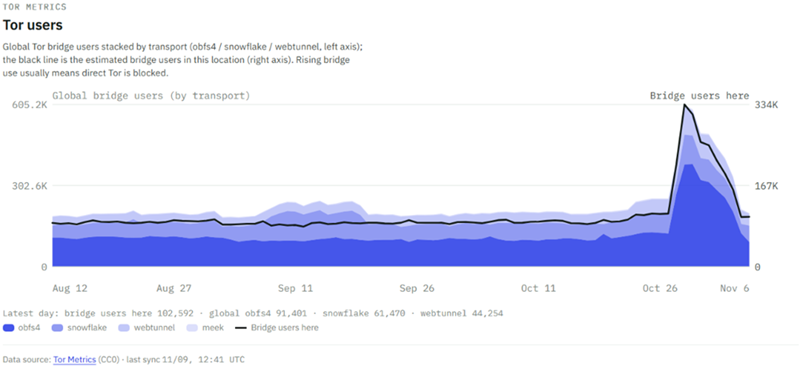
OONI’s real-world proxy connectivity measurements showed that Tor Snowflake established successful connections more frequently than the other tested transports. Tor Snowflake recorded a 30% connection success rate in Russia, compared with just 1% for direct Tor connections.
Similarly, Russians are widely adopting Tor Bridges to bypass internet restrictions. According to TorWatch’s analysis of Tor Metrics data, Russia had approximately 91,624 estimated daily Tor bridge users between September 20 and October 19, 2026, representing 42.7% of the global total.
Limitations
- Inconsistent connectivity is the major disadvantage of Tor Bridges. Russian ISPs can easily detect and block specific bridges or pluggable transports. So, users would have to switch to a new connection.
- Tor routes traffic through multiple relays, which can increase latency and reduce connection speeds. This makes streaming, online gaming, and large file downloads less practical.
5. Psiphon
Psiphon is an easy-to-use alternative to VPN for Russian users. This advanced censorship-circumvention tool combines tunnelling and proxy technologies to unblock restricted apps and sites. Although Psiphon remains a useful tool for bypassing internet censorship, its popularity could put it on Russian regulators’ radar for future blocking attempts. You may need to use mirror links or contact the official email address to access the service properly.

How Does Psiphon Work?
Psiphon relies on VPN, SSH, and HTTP proxy technology to route internet traffic beyond censored networks and overcome online restrictions. This VPN alternative scans for available servers and automatically switches between connection methods. It also favors transport protocols and servers that worked in previous sessions.
Does Psiphon work in Russia? Real-world testing results
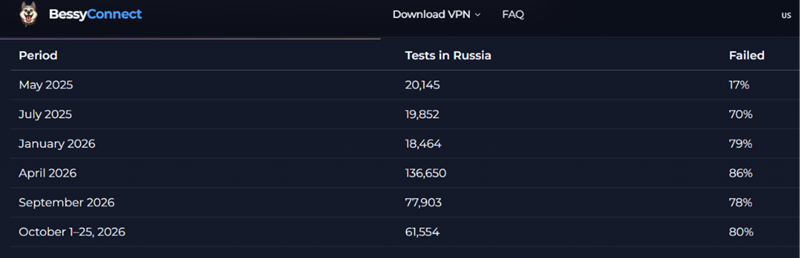
Although the DigitalCruch team had a positive impression of Psiphon, but testing results in Russia told a different story. OONI measurements analyzed by BessyConnect paint a challenging picture for Psiphon, with connection failures reaching approximately 80% in Russia.
Recent testing results share a high failure rate across all three networks:
- Rostelecom: 83% failure rate across 19,601 tests.
- Beeline: 90% failure rate.
- MTS: 85% failure rate.
Psiphon recorded fewer connection failures in earlier years, but recent restrictions have hurt its reliability.
Limitations
- Psiphon is less reliable than several other VPN alternatives in Russia, which may make users hesitant to rely on it.
- High connection failure rates, easier DPI detection, and inconsistent speeds are among Psiphon’s main drawbacks.
Final Words
Finding a dependable way to access the open internet in Russia is becoming increasingly difficult, particularly when conventional VPNs fail. You are not entirely out of options. VLESS + REALITY, AmneziaWG, Hysteria2, Tor bridges, and Psiphon offer alternative ways to navigate internet restrictions. With that in mind, DigitalCruch brings readers an unbiased, thoroughly researched, and non-sponsored review of these censorship-circumvention technologies. Our review also includes hands-on testing to show how these tools perform under real-world conditions.
However, we would also love to hear firsthand experiences from Russian users who have tried these alternative technologies. You can also share which technologies, beyond traditional VPNs, you use to access the open internet in Russia.